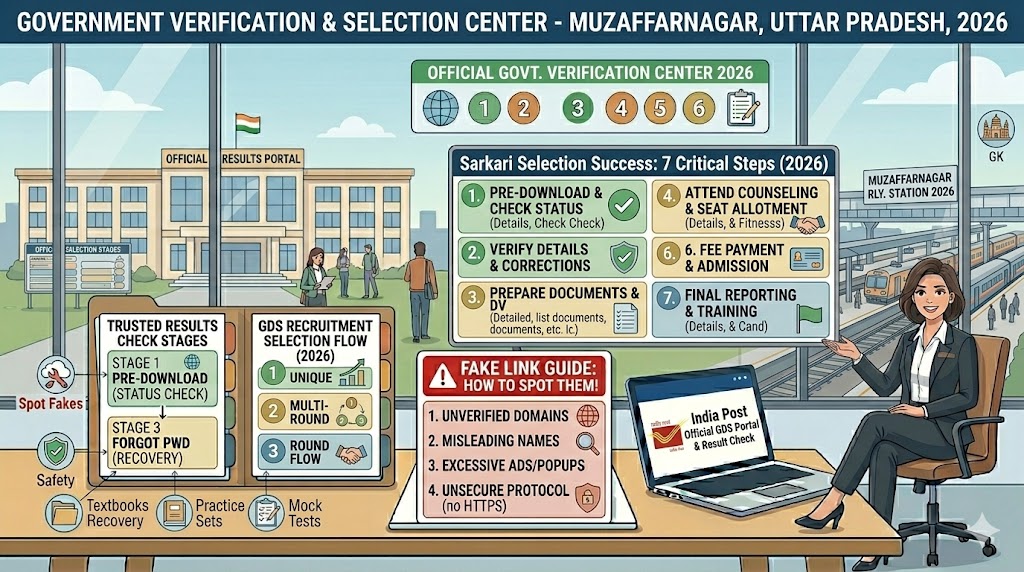
Finding your roll number in a result PDF is the moment every aspirant works toward. But the process does not end there — it accelerates. Between the result notification and your actual joining date, there are multiple stages where provisionally selected candidates lose their seats: not for lack of qualification, but for being unprepared for what comes after.
This guide is a step-by-step roadmap of exactly what to do once your result is out, so that every stage between result and joining goes smoothly.
Why Candidates Lose Their Seat After Qualifying
Each year, a significant number of provisionally selected candidates are rejected at post-result stages because of:
-
Document details (name, DOB, category) that do not match the application form
-
Missing, expired, or wrong-format caste/EWS/domicile certificates
-
Medical conditions that surface at the health examination
-
Missed official communication because of an inactive phone number or unchecked email
-
Carrying photocopies without self-attestation
-
Hiding medical history that later surfaces in service records
Every one of these is avoidable. That is what these seven steps address.
Step 1 — Read the Full Result Notification, Not Just Your Roll Number
Most candidates search only for their roll number, then close the PDF. Everything they missed is what determines whether they keep the seat.
Every official result notification from SSC, Railways, UPSC, state PSCs, and other boards contains:
-
The next stage of selection — DV, Physical Efficiency Test, medical, or a combination
-
Exact deadline for the next stage
-
Full list of documents required
-
Special instructions for reserved category candidates
-
A statement confirming that selection is provisional — not final
Download the complete result PDF from the official website (not a third-party aggregator). Read every page including footnotes and annexures. Note every deadline. Save the file on both your phone and your computer — you will refer to it multiple times in the coming weeks.
Missing a deadline mentioned in the official notification is the most common and most avoidable reason for losing a government job seat.
Step 2 — Collect and Verify All Documents on Day One
Document collection should begin the same day you confirm your selection. Not the week before DV. The same day.
Standard documents required at government job DV:
The name-match rule — the most common rejection trigger: Every document you carry must have identical spelling of your name, father’s name, and date of birth as your application form. Even one character difference — “Manish” vs “Manesh,” “Kuamr” vs “Kumar” — is flagged at DV. Verification officers are not lenient about this, and they are not empowered to make exceptions.
If you find any mismatch between documents: apply for correction at the issuing authority immediately. Additionally, get a notarised affidavit explaining the discrepancy as a supporting document. Do not assume you can explain it verbally on the day — it may not be accepted.
Step 3 — Prepare Self-Attested Sets in Advance
DV centres process dozens of candidates per day. They require originals plus two sets of self-attested photocopies of every document. Originals are returned the same day after verification.
What self-attestation means: Sign your name and write “Self-Attested” on each photocopy in blue or black ink. This is different from gazetted officer attestation — check your DV call letter carefully to confirm which type is required for each document.
Organise your file in the exact sequence mentioned in the DV call letter. A neatly ordered document file saves time at the desk and signals preparedness. Authorities notice the difference.
Step 4 — Prepare for the Medical Examination Without Shortcuts
For most central government posts — Railways, SSC, Police, Paramilitary (CISF, CRPF, BSF), Postal, and Defence — medical fitness is a mandatory selection stage.
Common tests conducted:
-
Vision: Colour blindness, near and far vision acuity. Standards are strict for Railways, Police, and Defence — check the exact standard for your post
-
Hearing: For field-level and operational roles
-
Blood pressure and ECG: Basic cardiovascular check for all central government posts
-
Chest X-ray: Respiratory health, TB screening
-
Blood tests: CBC, blood group, blood sugar, haemoglobin
-
BMI and physical measurements: Height, weight, and body proportions relevant to the post
-
Dental and ENT: For CISF, SSB, and defence-related posts
Understanding the two outcomes:
If declared TMU (Temporarily Medically Unfit) — meaning the condition is treatable — you may be allowed to request a review board within a specified number of days. If declared permanently medically unfit, candidature is cancelled and the seat moves to the next candidate in the merit list.
What to do before the medical date:
Get a general health check at a private clinic 2–3 weeks before. If you have borderline blood pressure, blood sugar, or vision, consult a doctor immediately and begin managing it. Avoid alcohol and excessive processed food in the two weeks prior.
Crucially: do not hide any health condition. Suppressing medical history at the time of joining is grounds for termination after appointment — it surfaces in service records and is treated as a false declaration.
Step 5 — Respond to Every Official Communication Without Delay
Government recruitment boards communicate through:
-
Email to your registered address
-
SMS to your registered mobile number
-
Official website notification
-
Speed post or registered post to your permanent address
Candidates lose seats every cycle because they changed their mobile number, stopped checking their application-registered email, or were not present at their permanent address when official correspondence arrived.
Right now, do these four things:
Check your application-registered email every day until joining is complete. Confirm your registered mobile number is still active. Tell a family member at your permanent address to watch for any speed post or registered letter from the exam board. Keep your DV call letter and appointment correspondence safe.
If you do not receive any communication within the expected timeframe: check the official board website directly, then contact the official helpline number from the notification. Do not rely on WhatsApp groups or Telegram channels for official updates — they are the last to be accurate and the first to spread misinformation.
Step 6 — Complete Pre-Appointment Formalities Accurately
After DV and Medical, most central government posts require pre-appointment formalities before the official offer letter is issued.
Attestation Form (Form No. 3 or equivalent): A detailed form covering your education history, residence history since birth, family background, and any criminal record — including cases that were later dismissed. Fill this with absolute accuracy. False declaration on this form is grounds for termination even after years in service, when the discrepancy surfaces in police verification.
Character and Antecedent Verification: The department sends your details to the police station at your permanent address. They verify criminal records, pending court cases, and character references. If there are pending cases — even minor ones — this is where they appear.
Declaration Form: Confirms you are not currently in government service (or that you have an NOC if you are), that you have no pending criminal proceedings, and that all information provided is accurate.
Reserved category certificate requirements:
-
OBC candidates: Certificate must be in central government format and must confirm your caste falls below the creamy layer. The ₹8 lakh per annum income limit applies to income from “other sources” such as business, rent, and professional income — salary income and agricultural income are excluded under the applicable OM. If unsure, verify with the certificate issuing authority.
-
EWS candidates: Certificate must be valid for the current financial year. EWS certificates are typically valid for one year from date of issue, but many issuing authorities align validity with the financial year (April 1 – March 31). If your certificate was issued before April 1, 2025, get a fresh one for FY 2025-26 before appearing for DV.
-
SC/ST candidates: Certificate must be from the competent district authority and must explicitly mention the constitutional schedule under which the caste is listed.
Step 7 — Prepare for Joining and the Training Period
After all stages clear, your official Appointment / Joining Letter arrives by speed post or email.
When the letter arrives:
Read every line — specifically the reporting date, reporting location, and what to bring. Respond or report on exactly the date mentioned. Missing the joining date without written prior permission can result in your candidature being cancelled and the offer going to the next candidate on the merit list.
Documents to carry on Day 1:
-
Original joining letter
-
Complete original document set (same as DV)
-
Two sets of self-attested photocopies
-
4–8 passport-size photographs
-
Bank account details for salary account setup (many departments specify a designated bank)
-
Medical fitness certificate from the examination stage
Training period: Most SSC posts require mandatory foundational training before you assume official duties. For SSC CGL, this is typically 2–3 months for most posts and approximately 6 weeks for Inspector-level roles. Training is residential at the designated training institute, with attendance compulsory. Unjustified absence delays confirmation of service.
Your probation period of 1–2 years begins after training completion — not from your date of joining. Use the training period to understand your service rules, grade pay, leave rules, and departmental conduct regulations. Ignorance of service rules is not an acceptable defence later.
Common Mistakes That Cost Candidates Their Seat
-
Treating provisional selection as final selection — it is not
-
Not reading the complete result notification — only looking for the roll number
-
Carrying photocopies without self-attestation
-
OBC certificate in state format for a central government post
-
EWS certificate from a previous financial year
-
Hiding a medical condition that later surfaces in health examination or service records
-
Inactive registered phone number or unchecked email missing official communication
-
Missing the DV or medical appointment without written prior intimation to the board
Post-selection processes, document requirements, and training durations vary by department and post. Always verify from the official notification issued by your specific recruiting board.
This website is independent and not affiliated with SSC, UPSC, Railways, DoPT, or any government department.
Written by Manish | Government exam preparation | sarkariexamresults.net