Child Development and Pedagogy (CDP) is the most important section in the UPTET exam — compulsory in both Paper 1 (Primary Level, Classes 1–5) and Paper 2 (Upper Primary Level, Classes 6–8), carrying 30 marks in each paper, and the section where most serious candidates either build a dominant score advantage or lose marks through conceptual confusion.
Unlike subject-specific sections where you either know the answer or don’t, CDP is a thinking subject — it tests whether you understand how children develop, how they learn, what motivates them, and how a teacher should respond to learning difficulties in a real classroom.
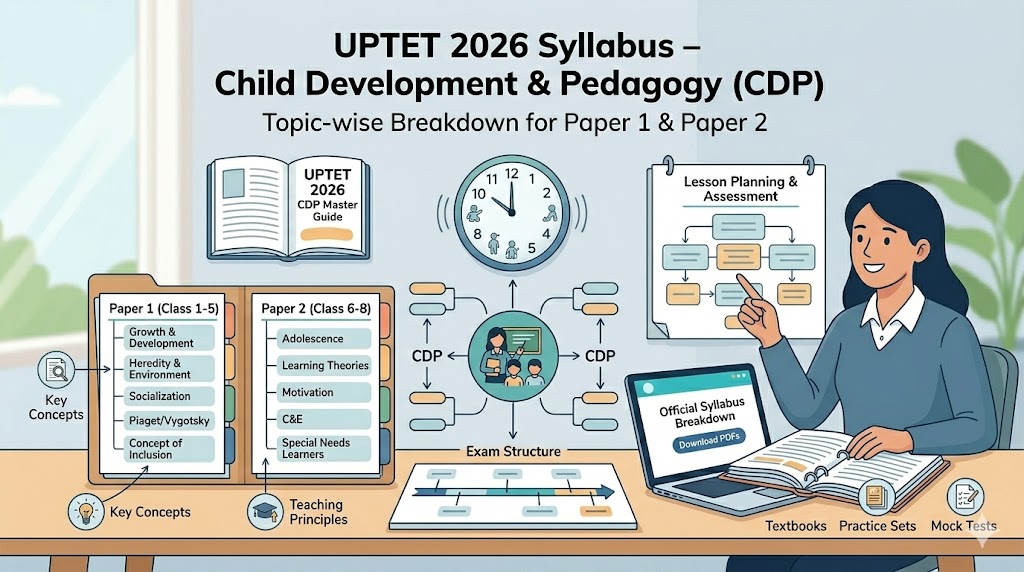
Rote memorisation of theorist names is not enough. Understanding the core concept behind each theory — and applying it to practical classroom scenarios — is what separates high-scorers from average performers.
This guide gives you the complete UPTET 2026 CDP syllabus for both Paper 1 and Paper 2, topic-by-topic with sub-topics, theorist summaries, previous year question patterns, and a preparation strategy.
UPTET 2026 – Exam Overview
| Parameter | Details |
|---|---|
| Conducting Body | Uttar Pradesh Basic Education Board (UPBEB) |
| Official Website | updeled.gov.in |
| UPTET 2026 Exam (Expected) | July 2026 |
| Papers | Paper 1 (Classes 1–5) + Paper 2 (Classes 6–8) |
| CDP in Paper 1 | 30 questions, 30 marks |
| CDP in Paper 2 | 30 questions, 30 marks |
| Total Marks per Paper | 150 marks (5 sections × 30 marks) |
| Duration | 150 minutes per paper |
| Negative Marking | None |
| Medium | Hindi and English (bilingual) |
CDP Weightage in the Full UPTET Paper
| Section | Questions | Marks | Compulsory? |
|---|---|---|---|
| Child Development & Pedagogy (CDP) | 30 | 30 | ✅ Yes — both papers |
| Language 1 (Hindi) | 30 | 30 | ✅ Yes |
| Language 2 (English/Urdu/Sanskrit) | 30 | 30 | ✅ Yes |
| Mathematics | 30 | 30 | Paper 1 / Optional Paper 2 |
| Environmental Studies / Subject-specific | 30 | 30 | As applicable |
| Total | 150 | 150 |
CDP contributes 20% of total marks in each paper — but its conceptual framework also underpins the pedagogy sub-section in every subject section, making CDP understanding a multiplier across the whole paper.
CDP Syllabus – Three-Part Official Structure
The UPTET CDP syllabus is officially divided into three broad parts:
| Part | Name | Core Focus |
|---|---|---|
| Part A | Child Development | How children grow — physically, mentally, emotionally, linguistically |
| Part B | Learning and Principles of Learning | How learning happens — theories, laws, conditioning models |
| Part C | Learning and Teaching | How teachers should teach — pedagogy, inclusion, motivation, assessment |
This three-part structure applies to both Paper 1 and Paper 2. Questions grow more application-oriented and scenario-driven from Paper 1 to Paper 2.
Part A: Child Development – Complete Topic Breakdown
1. Meaning, Need, and Scope of Child Development
-
Child development vs. child psychology: Child development is broader — it studies all systematic changes from conception to adolescence across physical, cognitive, emotional, social, and language dimensions. Child psychology focuses specifically on mental and behavioural aspects.
-
Growth vs. Development: Growth is quantitative (height, weight). Development is qualitative (maturity, capability). Growth is limited and stops; development is lifelong and continuous.
-
Need: Understanding development helps teachers match teaching strategies to the child’s current developmental stage — a concept directly linked to Piaget’s stage theory.
2. Stages of Child Development
| Stage | Age Range | Key Characteristics |
|---|---|---|
| Prenatal | Conception to birth | Germinal, embryonic, foetal phases |
| Infancy | Birth to 2 years | Rapid physical growth, sensorimotor learning |
| Early Childhood | 2–6 years | Language development, symbolic thinking, play |
| Middle Childhood | 6–12 years | Concrete reasoning, social skills, formal school |
| Adolescence | 12–18 years | Abstract thinking, identity formation |
Paper 1 focus: Middle Childhood (6–12 years). Paper 2 focus: Late Middle Childhood into Early Adolescence (11–14 years).
3. Physical Development
-
Cephalocaudal principle: Development proceeds from head downward — head control develops before leg control.
-
Proximodistal principle: Development proceeds from centre outward — trunk control before finger control.
-
Motor development: Gross motor skills (crawling, walking, running) develop before fine motor skills (writing, drawing).
-
Puberty and adolescent physical changes are specifically relevant for Paper 2 (upper primary teachers must understand adolescent development).
4. Cognitive (Mental) Development – Piaget
Jean Piaget is the single most important theorist in UPTET CDP — questions from Piaget’s theory appear in almost every UPTET exam across all CDP sub-sections.
Piaget’s Four Stages of Cognitive Development:
| Stage | Age | Key Characteristics |
|---|---|---|
| Sensorimotor | Birth–2 years | Learning through senses and movement; object permanence develops at ~8 months |
| Pre-operational | 2–7 years | Symbolic thinking, egocentrism, animism, centration; cannot conserve |
| Concrete Operational | 7–11 years | Logical thinking about concrete objects; conservation, reversibility, classification develop |
| Formal Operational | 11+ years | Abstract and hypothetical thinking; deductive reasoning |
Key Piagetian concepts tested in UPTET:
-
Schema: Mental framework or blueprint for understanding the world.
-
Assimilation: Fitting new information into an existing schema without changing the schema.
-
Accommodation: Modifying an existing schema to incorporate new information that does not fit.
-
Equilibration: The ongoing balance between assimilation and accommodation — the driving force of cognitive development.
-
Conservation: Understanding that quantity does not change despite changes in appearance — develops at the Concrete Operational stage (around age 7). Classic example: same amount of water looks different in a tall thin glass vs. a short wide glass.
-
Egocentrism: Child’s inability at the pre-operational stage to see the world from another person’s perspective. Classic example: three-mountain task.
-
Object Permanence: Understanding that objects continue to exist even when out of sight — develops at approximately 8 months in the sensorimotor stage.
5. Emotional Development – Erikson
Erik Erikson’s Eight Stages of Psychosocial Development is the primary emotional development theory tested in UPTET:
| Stage | Age | Crisis | Positive Resolution |
|---|---|---|---|
| Trust vs. Mistrust | 0–1 year | Can I trust the world? | Hope and security |
| Autonomy vs. Shame/Doubt | 1–3 years | Can I act independently? | Will and self-control |
| Initiative vs. Guilt | 3–6 years | Can I take initiative? | Purpose and direction |
| Industry vs. Inferiority | 6–12 years | Am I competent? | Confidence — most tested for Paper 1 |
| Identity vs. Role Confusion | 12–18 years | Who am I? | Clear identity — most tested for Paper 2 |
The Industry vs. Inferiority stage (6–12 years) is specifically relevant for Paper 1 — a child in this stage needs teachers to provide achievable challenges and recognition of competence to avoid developing feelings of inferiority.
6. Language Development
-
Stages: Cooing (0–6 months) → Babbling (6–12 months) → First words (12–18 months) → Two-word phrases (18–24 months) → Telegraphic speech → Complex sentences (3–5 years).
-
Chomsky’s Language Acquisition Device (LAD): Children are born with an innate biological mechanism for language acquisition — explains why all children, regardless of culture, acquire language in the same sequence.
-
Vygotsky’s view: Language and thought are interrelated and co-develop through social interaction — language is the tool of thought. Inner speech (talking to oneself) is a bridge between social speech and thought.
-
Bilingualism and multilingual classrooms — Indian classroom reality.
7. Social Development – Kohlberg
Kohlberg’s Theory of Moral Development is one of the highest-frequency topics in UPTET CDP:
| Level | Stage | Age (Approx.) | Moral Reasoning Basis |
|---|---|---|---|
| Pre-conventional | Stage 1: Punishment/Obedience | Below 9 years | Avoid punishment |
| Pre-conventional | Stage 2: Self-interest/Reward | Below 9 years | Gain reward |
| Conventional | Stage 3: Good boy/Good girl | 9–15 years | Seek social approval |
| Conventional | Stage 4: Law and Order | 9–15 years | Follow rules and authority |
| Post-conventional | Stage 5: Social Contract | Adult | Uphold social agreement |
| Post-conventional | Stage 6: Universal Principles | Adult | Follow universal ethics |
8. Personality Development
-
Freud’s Psychoanalytic Theory: Personality has three structures — Id (instinctual drives, pleasure principle), Ego (reality principle, mediates between Id and reality), Superego (moral conscience, internalised parental and social standards).
-
Carl Jung: Introvert (energy directed inward) vs. Extrovert (energy directed outward) personality types.
-
Allport’s Trait Theory: Personality as a set of stable, enduring traits.
-
Factors affecting personality: Heredity, family environment, peer group, school, culture, media.
9. Creativity
-
Characteristics of creative children: Divergent thinking (generating multiple solutions), curiosity, flexibility, originality, risk-taking.
-
Guilford’s model: Divergent production is the core cognitive process underlying creativity — contrasted with convergent thinking (one correct answer).
-
Teacher’s role: Open-ended questions, project-based learning, tolerance for unusual ideas, avoiding excessive evaluation pressure.
-
Creativity and IQ are not the same — a child can be highly creative without a high measured intelligence score.
10. Factors Affecting Child Development
| Factor | Key Points |
|---|---|
| Heredity | Sets genetic potential and upper ceiling for certain abilities |
| Family | Parenting styles (authoritative, authoritarian, permissive), sibling influence, family structure |
| Peer Group | Socialisation, identity formation, especially in adolescence |
| School | Teacher quality, school climate, curriculum design |
| Media | Television, internet, social media — positive and negative influences |
| Nutrition | Malnutrition affects both physical growth and cognitive development |
Part B: Learning and Principles of Learning
1. Meaning and Nature of Learning
-
Definition: Learning is a relatively permanent change in behaviour resulting from experience or practice — not caused by maturation, fatigue, or temporary states.
-
Characteristics: Purposeful, active, experience-based, product of interaction with environment.
-
Factors affecting learning: Motivation, attention, maturity, prior knowledge, health, practice, reinforcement, and feedback.
2. Learning Theories – Highest Frequency Topic in CDP
Learning theories consistently generate 8–10 questions out of 30 in the CDP section — the single highest-priority topic cluster.
Thorndike’s Connectionism (Trial and Error)
-
Principle: Learning occurs through repeated trial and error — incorrect responses are gradually eliminated as correct responses are reinforced.
-
Three Primary Laws:
-
Law of Readiness: Learning is more effective when the organism is ready and motivated.
-
Law of Exercise: Connections strengthen with use and weaken with disuse.
-
Law of Effect: Responses followed by satisfaction are strengthened; responses followed by discomfort are weakened.
-
-
Classroom application: Practice and immediate positive feedback reinforce correct responses.
Pavlov’s Classical Conditioning
-
Principle: A neutral stimulus, when repeatedly paired with an unconditioned stimulus, eventually produces the conditioned response on its own.
-
Classic experiment: Bell (neutral) + Food (unconditioned) → Salivation. Eventually: Bell alone → Salivation.
-
Key terms: UCS (Unconditioned Stimulus), CS (Conditioned Stimulus), UCR (Unconditioned Response), CR (Conditioned Response); Extinction (CS alone stops producing CR), Generalisation (CR produced to similar stimuli), Discrimination (CR only to the specific CS).
-
Classroom application: Positive classroom atmosphere paired with learning success → positive attitude toward learning.
Skinner’s Operant Conditioning
-
Principle: Behaviour is shaped by its consequences — reinforcement increases the likelihood of behaviour repeating; punishment decreases it.
-
Types of Reinforcement:
-
Positive: Adding a reward (praise, marks, stars).
-
Negative: Removing an unpleasant stimulus (removing homework burden when task is done well).
-
-
Schedules of reinforcement: Variable ratio produces the most persistent behaviour (e.g., unpredictable praise).
-
Classroom application: Reward systems, token economies, immediate specific feedback on assignments, behaviour modification programmes.
Kohler’s Insight Learning
-
Principle: Learning occurs through sudden understanding of the whole problem structure — an “Aha!” moment, not gradual trial and error.
-
Classic experiment: Sultan the chimpanzee suddenly used two short sticks to create one long stick to reach bananas — demonstrating complete, sudden insight.
-
Characteristics of insight: Sudden, complete, retained, transferable to similar problems.
-
Classroom application: Problem-solving activities, open-ended challenges, discovery learning.
Vygotsky’s Socio-Cultural Theory
-
Principle: Higher cognitive functions develop primarily through social interaction, guided by cultural tools — especially language.
-
Zone of Proximal Development (ZPD): The gap between what a child can accomplish independently and what they can accomplish with guidance from a teacher or more capable peer.
-
Scaffolding: Temporary, adjustable support provided within the ZPD — gradually reduced as the child gains competence and independence.
-
More Knowledgeable Other (MKO): The teacher, parent, or peer who provides guidance within the ZPD.
-
Classroom application: Cooperative learning, peer tutoring, guided discovery, group problem-solving.
Quick Comparison Table
| Theory | Theorist | Core Principle | Key Terms |
|---|---|---|---|
| Trial and Error | Thorndike | Practice + reinforcement | Laws of readiness, exercise, effect |
| Classical Conditioning | Pavlov | Stimulus-response association | CS, UCS, CR, extinction |
| Operant Conditioning | Skinner | Consequences shape behaviour | Reinforcement, punishment, schedules |
| Insight Learning | Kohler | Sudden understanding | Gestalt, “Aha!” moment |
| Socio-Cultural | Vygotsky | Social interaction drives cognition | ZPD, scaffolding, MKO |
| Cognitive Stages | Piaget | Active knowledge construction | Schema, assimilation, accommodation |
3. Plateau of Learning
-
A plateau is a period of no visible progress in learning despite continued practice.
-
Causes: Fatigue, loss of motivation, wrong method, physical illness, reaching a natural limits boundary before the next breakthrough.
-
Teacher’s role: Identify the specific cause, provide motivation, change teaching methodology, allow rest and recovery.
-
Plateaus are temporary — with correct intervention, progress resumes and often accelerates.
Part C: Learning and Teaching
1. How Children Think and Learn
-
Children are active constructors of knowledge — not passive receivers of information delivered by teachers (Piaget’s constructivist view).
-
New information is most effectively learned when it connects to existing knowledge structures (schemas).
-
Children’s errors are not random — they reveal underlying misconceptions and are valuable diagnostic tools.
-
Learning styles: Visual, Auditory, Kinaesthetic (VAK model) — teachers should use multi-modal teaching to reach all learner types.
2. Motivation and Learning
-
Intrinsic motivation: Driven by internal interest, curiosity, and personal satisfaction — more durable and produces deeper learning.
-
Extrinsic motivation: Driven by external rewards (marks, prizes, praise) — effective short-term but can undermine intrinsic motivation if overused.
-
Maslow’s Hierarchy of Needs: Physiological → Safety → Love/Belonging → Esteem → Self-actualisation. A child cannot concentrate on learning if basic physiological or safety needs are unmet — foundational principle for understanding school dropout and disengagement.
-
Teacher’s role: Safe and encouraging classroom climate, connecting learning to students’ interests, setting achievable but challenging goals.
3. Inclusive Education
One of the highest-frequency topics for Paper 2 CDP questions:
-
Definition: All children — regardless of disability, language, religion, gender, or socioeconomic background — learn together in the same regular classroom.
-
Right to Education Act 2009 (RTE): Free and compulsory education as a Fundamental Right for all children aged 6–14. Mandates inclusive education for children with disabilities in neighbourhood schools.
-
Types of learners requiring support:
-
Children with physical disabilities — visual impairment, hearing impairment, locomotor disability.
-
Children with intellectual disability.
-
Slow learners — take longer to grasp concepts; not intellectually disabled.
-
Gifted and talented children — need enrichment, not just repetition.
-
Socially disadvantaged children — SC/ST/minority/girl children from marginalised backgrounds.
-
-
Teacher’s strategies: Differentiated instruction, modified assessment, flexible grouping, peer support, early identification of learning needs, use of assistive technology.
4. Learning Disabilities
| Disability | What It Affects | Classroom Signs |
|---|---|---|
| Dyslexia | Reading and language processing | Letter reversals, difficulty decoding words, slow reading |
| Dysgraphia | Writing | Poor handwriting, difficulty organising written work |
| Dyscalculia | Mathematical reasoning | Counting difficulty, number order confusion |
| ADHD | Attention and impulse control | Inattention, hyperactivity, impulsive responses |
| ASD (Autism Spectrum) | Social communication | Difficulty with social cues, repetitive behaviours |
Critical principle: Learning disabilities are not related to intelligence — a child with dyslexia may have average or above-average intelligence. The disability affects a specific processing channel only.
5. Child-Centred and Progressive Education
-
Child-centred education: Curriculum, teaching methods, and assessment are designed around the child’s needs, interests, and learning pace — not around the textbook or teacher.
-
John Dewey’s Progressive Education: Learning by doing. Education must be practical, relevant to real life, and rooted in experience. School is a social institution preparing children for democratic participation.
-
NEP 2020 alignment: Competency-based learning, activity-based teaching, holistic development, reduced rote memorisation — all rooted in child-centred principles.
6. Teaching Methods and Strategies
| Method | Best Applied When |
|---|---|
| Lecture | Introducing new concepts to a large group |
| Demonstration | Teaching procedural or practical skills |
| Discussion | Developing critical thinking and opinion formation |
| Discovery/Inquiry | Encouraging independent problem-solving |
| Project Method | Developing integrated real-world understanding |
| Play-way | Primary level children (Classes 1–5) — Paper 1 focus |
| Cooperative Learning | Building social skills and peer learning |
7. Assessment and Evaluation
-
Formative Assessment: Ongoing during the learning process — classroom questions, observation, short tests. Purpose: Improve learning in real time.
-
Summative Assessment: At the end of a learning period — terminal exams, annual tests. Purpose: Measure achievement.
-
Continuous and Comprehensive Evaluation (CCE): Assesses both scholastic and co-scholastic areas (activities, values, attitudes) continuously throughout the year under the RTE framework.
-
Diagnostic Assessment: Identifies specific learning difficulties before or during teaching — used to detect gaps for remediation.
-
Error analysis: Understanding WHY a child made an error is more educationally valuable than counting wrong answers — reveals the underlying misconception needing correction.
Paper 1 vs Paper 2 CDP – Key Differences
| Aspect | Paper 1 (Classes 1–5) | Paper 2 (Classes 6–8) |
|---|---|---|
| Child age focus | 6–12 years (middle childhood) | 11–14 years (early adolescence) |
| Piaget stage focus | Concrete Operational | Transition to Formal Operational |
| Erikson stage focus | Industry vs. Inferiority | Identity vs. Role Confusion |
| Learning theory depth | Basic conceptual understanding | In-depth application to teaching scenarios |
| Inclusive education | General inclusion principles | Specific learning disabilities and strategies |
| Teaching methods | Play-way, activity, storytelling | Discussion, inquiry, problem-based learning |
| Question difficulty | Moderate | Moderate to High |
| NEP 2020 relevance | Primary education provisions | Upper primary + transition stage provisions |
Previous Year Question Pattern – CDP Analysis
Based on UPTET previous year papers (2019, 2021, 2023):
| Topic | Average Questions | Difficulty |
|---|---|---|
| Learning Theories (Piaget, Vygotsky, Skinner, Thorndike, Pavlov, Kohler) | 8–10 | Moderate to High |
| Inclusive Education & Learning Disabilities | 4–6 | Moderate |
| Child Development Stages | 3–4 | Easy to Moderate |
| Motivation and Learning | 2–3 | Moderate |
| Teaching Methods and Pedagogy | 2–3 | Moderate |
| Kohlberg’s Moral Development | 2–3 | Moderate |
| Assessment and Evaluation (CCE, RTE) | 2–3 | Easy to Moderate |
| Erikson’s Psychosocial Stages | 1–2 | Moderate |
| Creativity | 1–2 | Easy |
| Language Development | 1–2 | Easy |
Learning theories collectively generate 30–35% of all CDP questions. This is the single highest-priority cluster in the entire CDP syllabus.
3-Month CDP Preparation Plan
Month 1: Theory Foundation
-
Week 1: Complete Part A — all child development topics with structured notes.
-
Week 2: Learning theories — Thorndike, Pavlov, Skinner (create comparison charts for all three).
-
Week 3: Learning theories — Piaget, Vygotsky, Kohler (with classroom application examples for each).
-
Week 4: Erikson (8 stages table), Kohlberg (3 levels × 6 stages table), Freud (Id/Ego/Superego).
Month 2: Application and Practice
-
Week 5: Part C topics — inclusive education, learning disabilities, child-centred methods.
-
Week 6: Assessment (formative/summative/CCE), motivation, RTE Act 2009 key provisions, NEP 2020.
-
Week 7: 30 CDP previous year questions daily — analyse every wrong answer for the specific concept tested.
-
Week 8: Full CDP section mock tests — all 30 questions timed at 25 minutes.
Month 3: Revision and Consolidation
-
Daily: 30 CDP practice questions.
-
Weekly: One full UPTET paper (150 questions, 150 minutes).
-
Focus: Application-based scenario questions — “Which theory does THIS teacher action reflect?” type.
-
Final week: Revise one-page theory summaries only — Piaget stages, Vygotsky ZPD, Skinner reinforcement types, Kohlberg stages, Erikson crisis table.
Recommended Books for UPTET CDP
| Book | Publisher/Author | Best For |
|---|---|---|
| Child Development and Pedagogy | Arihant Publications | Complete CDP — most widely used for UPTET |
| NCERT Psychology Textbook | NCERT (Class 11–12) | Learning theories at source level |
| UPTET Paper 1 & 2 Complete Guide | Disha Experts | Combined syllabus preparation |
| Previous Year Question Papers | Kiran/Arihant | Pattern-based practice |
FAQs
Q. Is the CDP syllabus the same for UPTET Paper 1 and Paper 2?
The topic framework is identical — the same theories and concepts appear in both papers. However, Paper 2 requires deeper conceptual understanding and more application-based judgment, especially for inclusive education, learning theories, and adolescent development.
Q. Which theorist carries the most weightage in UPTET CDP?
Jean Piaget is the most tested — his four stages and key concepts (schema, assimilation, accommodation, conservation, egocentrism, object permanence) appear in virtually every UPTET exam. Vygotsky’s ZPD and scaffolding are the second most tested concepts.
Q. Is there negative marking in UPTET 2026?
No. UPTET has no negative marking in any section. A wrong answer scores zero — not a deduction. All 150 questions must be attempted in every UPTET paper.
Q. What is the qualifying score for UPTET 2026?
General/Unreserved candidates require 60% (90/150 marks). SC/ST/OBC/PwD candidates require 55% (82/150 marks). The UPTET certificate has lifetime validity — no expiry.
Q. Does UPTET CDP preparation help for CTET?
Yes — significantly. The CDP syllabus for UPTET and CTET is nearly identical. Both exams test the same theorists, the same inclusive education framework, and similar application-based pedagogy questions. Candidates preparing for UPTET CDP are simultaneously preparing for CTET Paper 1 and Paper 2 CDP.