The UP Police Constable 2026 recruitment — announced by the Uttar Pradesh Police Recruitment and Promotion Board (UPPRPB) — is one of the most significant state government job opportunities in India, with 32,679 vacancies open to candidates who have passed Class 12 (Intermediate) from a recognised board.
For aspirants across Uttar Pradesh — and especially candidates from districts like Muzaffarnagar, Meerut, Lucknow, Varanasi, Agra, and Gorakhpur — this is the most accessible uniformed government job in the state with a clear, structured syllabus and a transparent selection process.
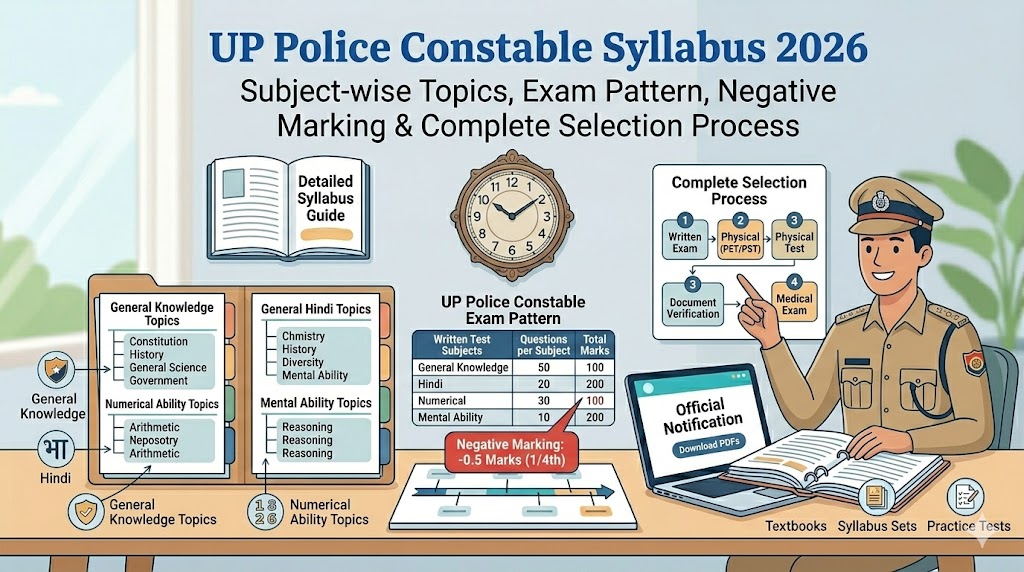
Two updates make the 2026 exam pattern different from previous cycles: First, negative marking has been removed — the 2026 exam pattern carries no deduction for wrong answers, meaning all 150 questions should be attempted without hesitation. Second, the exam is OMR-based offline, not computer-based — candidates mark answers on an OMR sheet with a pen, not on a computer screen.
This guide covers the complete UP Police Constable syllabus, section-wise topics, the revised exam pattern, physical standards, and a preparation strategy.
UP Police Constable 2026 – Recruitment Overview
| Parameter | Details |
|---|---|
| Conducting Body | UP Police Recruitment and Promotion Board (UPPRPB) |
| Official Website | uppbpb.gov.in |
| Post | Constable (Sipahi) |
| Total Vacancies | 32,679 |
| Minimum Qualification | Class 12 (Intermediate) pass from a recognised board |
| Age Limit | 18–22 years (with category-wise relaxation) |
| Exam Mode | Offline — OMR-based |
| Official Language | Hindi (and English) |
Selection Process – Four Stages
| Stage | Name | Nature |
|---|---|---|
| Stage 1 | Written Examination | Merit-forming |
| Stage 2 | Document Verification (DV) + Physical Standard Test (PST) | Qualifying |
| Stage 3 | Physical Efficiency Test (PET) | Qualifying |
| Stage 4 | Medical Examination | Qualifying |
Merit rule: The final merit list is based entirely on written examination marks. PET, PST, and Medical Examination are qualifying — they do not add marks to your score. Your written exam rank decides your position in the merit list; physical and medical tests decide whether you are eligible to occupy that position.
Written Exam Pattern 2026 – Complete Structure
The written exam is a 150-question, 300-mark, OMR-based objective test conducted in 2 hours:
| Section | Questions | Marks | Duration |
|---|---|---|---|
| General Knowledge (General Science) | 38 | 76 | — |
| General Hindi | 37 | 74 | — |
| Numerical & Mental Ability Test | 38 | 76 | — |
| Mental Aptitude / Intelligence Quotient / Reasoning | 37 | 74 | — |
| Total | 150 | 300 | 120 minutes |
Key Exam Rules
-
Marking scheme: Each correct answer awards +2 marks — questions carry 2 marks each.
-
Negative marking: NONE — the 2026 exam pattern has removed negative marking entirely. Wrong answers score zero, not a deduction.
-
Duration: 2 hours (120 minutes).
-
Mode: Offline — OMR sheet, pen-based. Not computer-based.
-
Medium: Hindi and English (bilingual).
-
Minimum qualifying marks:
-
General / Unreserved: 30% (90 out of 300 marks)
-
OBC / EWS: 25% (75 out of 300 marks)
-
SC / ST: 20% (60 out of 300 marks)
-
No negative marking strategy: Since wrong answers carry zero penalty, attempt all 150 questions without exception. Even a random guess has a 25% chance of adding 2 marks. Never leave a question blank in UP Police Constable 2026.
Section 1: General Knowledge / General Science (38 Questions, 76 Marks)
This is the highest-question-count section — 38 questions across History, Geography, Polity, Economics, Science, and Current Affairs, with a specific emphasis on UP-specific GK that other state-level guides frequently underemphasise.
History of India (7–8 Questions)
Ancient India:
-
Indus Valley Civilisation — major sites, features, decline.
-
Vedic period — Rigvedic society, later Vedic developments.
-
Maurya Empire — Chandragupta Maurya, Ashoka’s Dhamma, Edicts.
-
Gupta Empire — Golden Age of India, art, literature, science.
-
Buddhism and Jainism — founders, doctrines, spread.
Medieval India:
-
Delhi Sultanate — major sultans, administrative system.
-
Mughal Empire — Akbar (Navratnas, Din-i-Ilahi, administrative reforms), Aurangzeb.
-
Bhakti and Sufi movements — Kabir, Mirabai, Raidas, Tulsidas (especially relevant for UP history).
-
Maratha and Sikh empires — basics.
Modern India:
-
British expansion — Subsidiary Alliance, Permanent Settlement, economic drain.
-
Revolt of 1857 — causes, major centres in UP (Meerut, Lucknow, Kanpur, Jhansi), leaders (Mangal Pandey, Begum Hazrat Mahal, Nana Sahib), outcome.
-
Freedom struggle — Non-Cooperation, Civil Disobedience, Quit India Movements.
-
Mahatma Gandhi, Bhagat Singh, Subhas Chandra Bose — roles.
-
India’s Independence and Partition (1947).
UP-specific History (High Priority):
-
Important rulers of Uttar Pradesh region — Awadh Nawabs, Jhansi ki Rani Lakshmibai.
-
Freedom fighters from UP — Chandrashekhar Azad (Allahabad), Ram Prasad Bismil (Shahjahanpur).
-
Archaeological sites in UP — Hastinapur, Mathura, Sarnath, Kushinagar, Shravasti.
Geography (6–7 Questions)
India Geography:
-
Physical features — Himalayas (ranges, major peaks), Northern Plains, Deccan Plateau, Coastal Plains.
-
Major rivers — Ganga, Yamuna, Brahmaputra, Godavari, Krishna, Kaveri; river systems.
-
Climate of India — monsoon mechanism, seasons, cyclones.
-
Natural vegetation and wildlife — biomes, national parks, Project Tiger.
-
Resources — minerals, energy, water, soil types.
-
Agriculture — Kharif, Rabi crops; major producing states.
-
States and Union Territories — capitals, important cities.
UP Geography (High Priority):
-
Rivers of UP — Ganga, Yamuna, Ghaghra, Gomti, Rapti, Betwa, Son, Chambal.
-
Districts and divisions of Uttar Pradesh — 75 districts across 18 divisions.
-
Geographical features — Terai region, Bundelkhand plateau, Vindhya ranges.
-
Agriculture in UP — sugarcane (UP is India’s largest producer), wheat, rice, potato, mentha (mint).
-
Industries in UP — sugar mills, leather industry (Agra, Kanpur), carpet weaving (Bhadohi), glass industry (Firozabad).
-
Important dams and reservoirs in UP — Rihand, Rajghat, Matatila.
-
National Parks and Wildlife Sanctuaries — Dudhwa National Park, Katerniaghat, Chandra Prabha.
Indian Polity & Constitution (5–6 Questions)
-
Preamble — key words, significance.
-
Fundamental Rights (Part III) — key articles (14, 19, 21, 32) and their provisions.
-
Fundamental Duties (Article 51A).
-
Directive Principles of State Policy — important DPSP.
-
Parliament — Lok Sabha and Rajya Sabha; composition, powers.
-
President and Vice President — election process, powers.
-
Prime Minister and Council of Ministers — role.
-
State government — Governor, Chief Minister, Vidhan Sabha, Vidhan Parishad.
-
Judiciary — Supreme Court, High Courts; writ jurisdiction.
-
Election Commission — powers and functions.
-
Panchayati Raj — 73rd Amendment, three-tier structure.
-
UP-specific polity — UP Vidhan Sabha, Allahabad High Court (largest in India).
Economics (4–5 Questions)
-
Basic economic terminology — GDP, GNP, per capita income, national income.
-
Five Year Plans and NITI Aayog — objectives and key differences.
-
Inflation — types, measurement (WPI, CPI), control measures.
-
RBI — functions, monetary policy tools (repo rate, CRR, SLR).
-
Union Budget basics — fiscal deficit, revenue deficit.
-
Major Central government schemes — PM-KISAN, MNREGA, Ayushman Bharat, PM Awas Yojana, Jal Jeevan Mission.
-
UP government schemes — UP One District One Product (ODOP), Kanya Sumangala Yojana, Mukhyamantri Abhyudaya Yojana.
General Science (8–9 Questions)
Physics:
-
Motion — speed, velocity, acceleration, Newton’s Laws.
-
Work, Energy and Power — kinetic and potential energy, conservation.
-
Sound — propagation, reflection, echo.
-
Light — reflection, refraction, optical instruments.
-
Electricity — Ohm’s Law, circuits, heating effect.
-
Magnetism — magnetic fields, electromagnets.
-
Modern physics basics — atomic structure, radioactivity (simple).
Chemistry:
-
Matter — states and changes.
-
Periodic table — groups, periods, key elements.
-
Acids, bases, salts — pH scale, common substances.
-
Metals and non-metals — properties, reactivity series.
-
Carbon compounds — fuels, common organic substances.
-
Environmental chemistry — pollution types and effects.
Biology:
-
Cell structure and functions.
-
Human body systems — digestive, respiratory, circulatory, nervous, excretory.
-
Diseases — bacterial (TB, typhoid), viral (dengue, COVID), protozoan (malaria); prevention.
-
Nutrition — vitamins, minerals, deficiency diseases.
-
Plants — photosynthesis, respiration basics.
Current Affairs (5–6 Questions)
-
National events — government decisions, policy launches, elections.
-
International affairs — summits (G20, SCO, BRICS), bilateral agreements.
-
Awards and Honours — Bharat Ratna, Padma Awards, Nobel Prize, Arjuna Award.
-
Sports — national and international championships, UP sports achievements.
-
Science and Technology — ISRO missions, defence launches, important tech announcements.
-
UP-specific current affairs — UP government budget, new schemes, appointments, infrastructure projects, UP investor summit.
Section 2: General Hindi / सामान्य हिन्दी (37 Questions, 74 Marks)
General Hindi is the only section tested exclusively in Hindi — no English translation is provided for this section. It tests grammar, vocabulary, comprehension, and language proficiency at Class 10–12 level.
Complete Hindi Syllabus
व्याकरण (Grammar):
-
संधि और संधि विच्छेद (Sandhi — vowel, consonant, and visarga sandhi with examples)
-
समास (Samas — compound words: Tatpurusha, Dvandva, Bahuvrihi, Avyayibhava)
-
उपसर्ग और प्रत्यय (Prefixes and Suffixes)
-
विलोम शब्द (Antonyms)
-
पर्यायवाची शब्द (Synonyms)
-
अनेकार्थी शब्द (Words with multiple meanings)
-
तत्सम और तद्भव शब्द (Sanskrit-origin words and their Hindi derivatives)
-
देशज और विदेशी शब्द (Native and foreign-origin words in Hindi)
-
वाक्यांश के लिए एक शब्द (One Word Substitution in Hindi)
-
मुहावरे और लोकोक्तियाँ (Idioms and Proverbs)
-
वर्तनी / शुद्ध वर्तनी (Spelling Correction)
-
वाक्य शुद्धि (Sentence Correction — grammatically correct sentence)
-
रस, छंद, अलंकार (Poetic elements — basic: Shringar Ras, Doha Chhand, Anuprasa Alankara)
-
लिंग, वचन, काल (Gender, Number, Tense)
-
कारक (Case markers — vibhaktis)
-
क्रिया और क्रिया विशेषण (Verbs and Adverbs)
Reading and Comprehension:
-
गद्यांश पठन बोध (Reading comprehension — 1–2 prose passages with inference and vocabulary questions)
-
पद्यांश (Poetry comprehension — theme, mood, figure of speech identification)
Practical Hindi:
-
पत्र लेखन की भाषा (Formal letter language — recognition level)
-
रिक्त स्थान पूर्ति (Fill in the blanks with correct grammatical form)
-
वाक्य क्रम (Sentence ordering)
Preparation note: Sandhi, Samas, Vilom Shabd, Paryayvachi, Muhavare, and Vakya Shuddhi together account for approximately 55–60% of all Hindi questions in UP Police exam history. These six topic areas are the non-negotiable preparation core for the Hindi section.
Section 3: Numerical & Mental Ability Test (38 Questions, 76 Marks)
This section is split between Numerical Ability (arithmetic) and Mental Ability — approximately 20 Maths and 18 Mental Ability questions, though the official notification does not specify an exact internal split.
Numerical Ability – Arithmetic Topics
| Topic | Expected Questions |
|---|---|
| Number System (LCM, HCF, divisibility, fractions) | 2–3 |
| Simplification and BODMAS | 1–2 |
| Percentage | 2–3 |
| Profit, Loss and Discount | 2–3 |
| Simple Interest and Compound Interest | 2–3 |
| Ratio and Proportion | 1–2 |
| Average | 1–2 |
| Time and Work | 1–2 |
| Time, Speed and Distance | 1–2 |
| Mensuration (area, perimeter, volume) | 1–2 |
| Algebra (basic equations and identities) | 1–2 |
| Use of Tables and Graphs (Data Interpretation) | 1–2 |
| Statistics (mean, median, mode) | 1 |
Priority cluster: Percentage + Profit & Loss + SI/CI + Time & Work + Ratio & Proportion account for approximately 45–50% of Numerical Ability questions — these five topics must be mastered before moving to geometry and mensuration.
Mental Ability Test (मानसिक क्षमता परीक्षण)
Mental Ability in UP Police tests practical thinking, perception, and cognitive speed — not just formal reasoning:
-
Logical diagrams (Venn diagrams)
-
Symbol-relationship interpretation
-
Codification (pattern-based symbol coding)
-
Perception test (visual identification)
-
Word formation test
-
Letter and number series
-
Word and alphabet analogy
-
Common sense test
-
Letter and number coding
-
Direction sense test
-
Logical interpretation of data
-
Forcefulness of argument (evaluating strong vs. weak arguments)
-
Determining implied meanings
Section 4: Mental Aptitude / Intelligence Quotient / Reasoning (37 Questions, 74 Marks)
This section tests three interrelated areas — Mental Aptitude (attitudes and values relevant to police service), Intelligence Quotient (IQ), and Logical/Reasoning Ability:
Mental Aptitude (मानसिक अभिरुचि)
This sub-section is unique to UP Police — it does not appear in SSC, Railway, or banking exams. It tests whether a candidate has the right orientation, values, and attitude for police service:
-
Public Interest (सार्वजनिक हित) — orientation toward serving the public.
-
Law and Order (कानून और व्यवस्था) — understanding and commitment to law enforcement.
-
Communal Harmony (सांप्रदायिक सौहार्द्र) — sensitivity toward different communities.
-
Crime Control (अपराध नियंत्रण) — attitude toward preventing and controlling crime.
-
Rule of Law (कानून का शासन) — belief in legal processes over personal judgment.
-
Ability of Adaptability (अनुकूलता) — flexibility in different policing situations.
-
Professional Information — Basic Level (व्यावसायिक जानकारी) — basic knowledge of police functions.
-
Police System (पुलिस व्यवस्था) — structure and functioning of UP Police.
-
Contemporary Police Issues and Law and Order — current challenges in policing.
-
Basic Law (बुनियादी कानून) — IPC, CrPC, Constitution basics as relevant to policing.
-
Interest in Profession (व्यवसाय में रुचि) — motivation for choosing police service.
-
Mental Toughness (मानसिक कठोरता) — resilience under pressure.
-
Sensitivity towards Minorities and Underprivileged — awareness of equity in policing.
-
Gender Sensitivity (लिंग संवेदनशीलता) — respectful attitude toward all genders.
How to prepare for Mental Aptitude: These questions present scenario-based situations — “A constable witnesses a senior officer taking a bribe. What is the correct response?” or “A communal conflict breaks out in your area. What is the first action?” The correct answers align with public interest, legal procedure, non-discrimination, and professional ethics — not personal judgment or community bias.
Intelligence Quotient (बुद्धिलब्धि / IQ)
Standard IQ-type questions:
-
Relationship and analogy test
-
Spotting the dissimilar (odd one out)
-
Series completion (number and letter)
-
Coding-decoding
-
Direction sense test
-
Blood relations
-
Problems based on alphabets
-
Time sequence test
-
Venn diagrams and chart-type tests
-
Mathematical operations and reasoning
Logical / Reasoning Ability
-
Similarity, equality, difference
-
Fill in the blanks (reasoning-based)
-
Problem-solving and analytical judgment
-
Decision-making ability
-
Visual memory and discrimination ability
-
Observation, relationship, and concept
-
Arithmetic reasoning
-
Word and figure classification
-
Number series
-
Understanding abstract ideas, symbols, and their relationships
-
Common sense applications
Physical Standard Test (PST) – Stage 2
PST is conducted after written exam qualification and DV — qualifying only:
| Measurement | Male (General/OBC/SC) | Male (ST) | Female (General/OBC/SC) | Female (ST) |
|---|---|---|---|---|
| Height | 168 cm | 160 cm | 152 cm | 147 cm |
| Chest (Male — unexpanded) | 79 cm | 77 cm | N/A | N/A |
| Chest (Male — expanded) | 84 cm | 82 cm | N/A | N/A |
| Weight (Female) | N/A | N/A | Proportionate to height | Same |
Physical Efficiency Test (PET) – Stage 3
PET events and standards — qualifying only, no marks added:
| Event | Male Standard | Female Standard |
|---|---|---|
| 4.8 km run | 25 minutes | Not required |
| 2.4 km run | Not required | 14 minutes |
The UP Police PET running standard is more achievable than SSC GD — 4.8 km in 25 minutes (male) requires a pace of approximately 5 minutes 12 seconds per km. However, it still requires 2–3 months of consistent running training to achieve comfortably on the PET day.
Medical Examination – Stage 4
Standard physical fitness examination by a government medical board:
| Parameter | Standard |
|---|---|
| Eyesight | 6/6 (better eye), 6/9 (worse eye); near vision Sn 0.6/Sn 0.8 |
| Colour vision | No significant colour blindness |
| Hearing | Normal in both ears |
| General fitness | No flat feet, knock knee, varicose veins, or significant deformity |
| Systemic health | No disqualifying chronic condition |
Age Relaxation Rules
| Category | Age Relaxation |
|---|---|
| OBC (UP Domicile) | 3 years |
| SC/ST (UP Domicile) | 5 years |
| Female (General) | 2 years |
| Female (OBC) | 5 years |
| Female (SC/ST) | 7 years |
| Ex-Servicemen | 5 years |
Subject-wise Weightage Summary
| Section | Questions | Marks | % of Paper |
|---|---|---|---|
| General Knowledge / General Science | 38 | 76 | 25.3% |
| General Hindi | 37 | 74 | 24.7% |
| Numerical & Mental Ability | 38 | 76 | 25.3% |
| Mental Aptitude / IQ / Reasoning | 37 | 74 | 24.7% |
| Total | 150 | 300 | 100% |
The four sections are almost perfectly balanced — within 2 marks of each other. This means no single section dominates the paper. A candidate who scores 70–75% in every section will comfortably outperform a candidate who scores 90% in two sections but only 50% in the other two.
Key Difference: 2026 Pattern vs Previous Cycles
| Parameter | Previous Cycles (2018–24) | 2026 Revised Pattern |
|---|---|---|
| Negative marking | 0.5 marks per wrong answer | No negative marking |
| Mode | Offline OMR | Offline OMR |
| Questions | 150 | 150 |
| Marks | 300 | 300 |
| Duration | 2 hours | 2 hours |
| Sections | 4 | 4 |
| Attempt strategy | Skip uncertain questions | Attempt all 150 |
The removal of negative marking is the most significant change in the 2026 pattern. In previous cycles, guessing wrong on an uncertain question cost 0.50 marks — now it costs nothing. Smart candidates who attempt all 150 questions have a statistical advantage over those who leave blanks.
5-Month Preparation Strategy
Month 1: GK + Hindi Foundation
-
Lucent’s General Knowledge — complete History, Geography, Polity (focus on UP-specific chapters).
-
NCERT Class 9–10 Science for General Science sub-section.
-
Hindi grammar: Start with Sandhi, Samas, Vilom Shabd, Paryayvachi — these four topics give the highest return per preparation hour.
-
Current Affairs: Begin a UP-focused monthly CA magazine.
Month 2: Maths + Reasoning
-
NCERT Class 8–10 Maths — Percentage, Profit & Loss, SI/CI, Ratio, Average, Time & Work.
-
R.S. Aggarwal Reasoning — Analogy, Series, Coding, Direction Sense, Blood Relations.
-
Mental Aptitude: Read UP Police Act basics, IPC sections relevant to police duty (Sections 96–106: right of private defence; Section 302: murder; Section 376: rape; Section 379: theft).
Month 3: Section-wise Practice
-
Daily: 38 GK questions, 37 Hindi questions.
-
Daily: 38 Maths/Mental Ability questions, 37 Reasoning/IQ/Aptitude questions.
-
Weekly: 2 UP Police previous year section-wise tests.
-
Physical training: Begin 2 km daily run.
Month 4: Full Paper Practice
-
3 full 150-question mock tests per week — strict 120-minute limit.
-
No negative marking strategy: Every question attempted, including uncertain ones.
-
Focus: Reduce time per question to under 45 seconds average (150 questions in 120 minutes).
-
Physical training: Build to 4.8 km continuous run.
Month 5: Revision + PET Training
-
Revise all 4 sections — GK notes, Hindi grammar rules, Maths formulas, Reasoning shortcuts.
-
UP Current Affairs for the last 8 months — daily 30-minute review.
-
Physical training: Achieve PET target time consistently — 4.8 km in under 24 minutes (aim for 22 minutes to have a safety margin).
Recommended Books for UP Police Constable 2026
| Subject | Recommended Resource |
|---|---|
| General Knowledge | Lucent’s General Knowledge + UP GK Special Edition |
| General Hindi | Arihant Samanya Hindi by Usha Yadav OR Dr. Brij Kishore Prasad Singh |
| Arithmetic | R.S. Aggarwal Arithmetic |
| Reasoning | R.S. Aggarwal Verbal & Non-Verbal Reasoning |
| Mental Aptitude | UP Police Constable Guide — Arihant/Kiran (specific UP Police aptitude chapter) |
| Current Affairs | Pratiyogita Darpan / GK Today monthly edition |
| Previous Papers | UP Police Constable Previous Year Papers — last 5 exam cycles |
| Official Notification | uppbpb.gov.in |
FAQs
Q. Is there negative marking in UP Police Constable 2026?
No — the 2026 exam pattern has removed negative marking entirely. Every question is worth +2 marks for a correct answer and 0 marks for a wrong answer. All 150 questions must be attempted.
Q. What is the total marks for UP Police Constable written exam?
300 marks — 150 questions worth 2 marks each. Duration is 2 hours.
Q. What is the minimum qualifying score for UP Police Constable 2026?
General/Unreserved: 30% (90 marks). OBC/EWS: 25% (75 marks). SC/ST: 20% (60 marks). However, actual competition means candidates typically need 55–65% or above for a realistic chance of selection.
Q. Is UP domicile mandatory for UP Police Constable?
Yes. UP Police Constable recruitment is specifically for UP domicile candidates. A valid UP domicile/residence certificate is mandatory at the Document Verification stage.
Q. What is the education qualification for UP Police Constable 2026?
Class 12 (Intermediate) pass from a recognised board. Class 10-only pass is not sufficient — UP Police Constable requires 12th pass, unlike SSC GD and Railway Group D which accept Matric.
Q. Is the Mental Aptitude section tested differently from normal Reasoning?
Yes. Mental Aptitude in UP Police Constable is unique — it tests your orientation toward police values, public service, law and order, communal harmony, and gender sensitivity through scenario-based MCQ questions. This is separate from the IQ and Logical Reasoning sub-sections in the same section.
Q. What is the PET standard for UP Police Constable male candidates?
Male candidates must complete a 4.8 km run in 25 minutes. This is the qualifying standard — no marks are awarded for finishing faster.
Q. Is the UP Police exam conducted online or offline in 2026?
The exam is offline — OMR-based (pen and paper). Candidates mark answers on an OMR sheet. It is not a computer-based test like SSC or RRB exams.
1 thought on “UP Police Constable Syllabus 2026 – Subject-wise Topics, Exam Pattern, Negative Marking & Complete Selection Process”