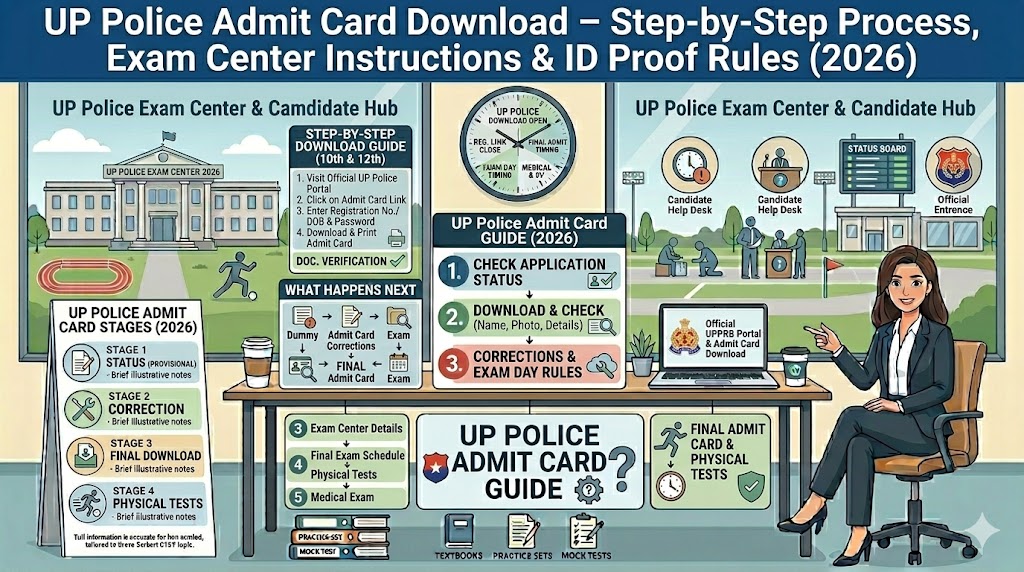
If you applied for UP Police Constable this cycle, your exam is coming in June 2026 — and the admit card will likely drop just 3 to 4 days before your exam date. That window is shorter than most candidates expect. When the link goes live on uppbpb.gov.in, you need to download, verify, and print without delay.
Here is everything you need to know — from login to gate entry.
Where Things Stand Right Now
Two separate UP Police recruitments are active simultaneously, and it is important not to confuse them:
UP Police Constable 2025-26 — 32,679 posts (Civil Police, PAC, Jail Warder and equivalent)
Applications closed January 30, 2026. Written exam: June 8, 9, and 10, 2026 in two shifts each day. Admit card expected May 2026 on uppbpb.gov.in
UP Police SI 2025-26 — 4,543 posts
Written exam already conducted: March 14–15, 2026. Result awaited.
UP Police SI/ASI 2025 (separate earlier cycle) — 921 posts
Written exam November 2, 2025; result declared December 10, 2025. Now in post-written stages.
The download process, ID rules, and exam centre instructions are identical across all these. What follows applies to every UP Police recruitment.
Getting Your Admit Card
Go directly to uppbpb.gov.in — not any search result, not any third-party site. Fake portals that mimic UPPBPB’s page surface during every exam admit card period.
On the homepage, look for the admit card notification banner for your specific post. Each recruitment has its own separate link — do not click the SI link if you applied for Constable.
Log in with your Registration Number and Date of Birth in DD/MM/YYYY format. Your admit card opens as a PDF. Before you touch the download button, read every field on screen:
Your name, your father’s name, date of birth, category, exam date, shift, and exam centre address. If anything is wrong — contact UPPBPB helpdesk at uppbpb@nic.in with your Registration Number immediately. Do not attend the exam with incorrect details hoping it will be overlooked.
Once verified: download, save to cloud storage as well as your device, and print minimum two copies on A4 paper. Black and white is fine — but the photograph must be clearly identifiable. If it prints faded, adjust your printer’s contrast or find a better machine.
Forgot your Registration Number? On the login page, click “Forgot Registration Number,” enter your Aadhaar number or registered mobile number with date of birth, and it will be retrieved. If that also fails — check your SMS inbox from December 2025/January 2026 for the UPPBPB application confirmation message. It contains your Registration Number.
The ID Proof Rules — Read This Carefully
UP Police exams use biometric verification at the exam gate — fingerprint scanning and facial recognition — which makes the ID proof rules stricter than most other government exams.
Aadhaar is not just preferred — it functions as your biometric backup. If the fingerprint scanner is inconclusive (common for candidates who do manual labour), the centre falls back to Aadhaar Authentication. A masked Aadhaar (showing only the last 4 digits) will not work for this purpose. Carry the full 12-digit physical Aadhaar or an e-Aadhaar downloaded from the UIDAI website.
Beyond Aadhaar, carry one additional photo ID as a second layer:
Voter ID, Passport, Driving Licence, PAN Card, Government Employee ID, College/University ID Card, or Bank Passbook with photograph are all accepted. Photocopies of any ID — even notarised — are not. An ID displayed on your phone screen is not accepted.
The simplest approach: Aadhaar in your pocket + one more ID. That combination handles every verification scenario the gate can throw at you.
What the Entry Process Actually Looks Like
Most candidates picture “showing the admit card at the gate and walking in.” The reality at UP Police exam centres takes considerably longer, and this is why the reporting time matters so much.
When you arrive at the centre, there are four sequential steps before you reach your seat:
Frisking at the outer gate — physical body frisk by same-gender staff and a hand-held metal detector scan. At a large centre with 400–500 candidates all arriving in the same window, this queue alone can take 45 to 60 minutes.
Document check — an official checks your printed admit card against your face, and your photo ID.
Biometric verification — your fingerprint is scanned and matched against your application data. A camera captures your face for facial recognition. If both match cleanly, you receive clearance and proceed. If either is inconclusive, Aadhaar Authentication is performed on the spot — this is why the full 12-digit Aadhaar matters.
If your fingerprints do not scan clearly because of manual work or dry skin: tell the Centre Superintendent before the verification, not after the scanner fails. Centre staff have an alternative procedure for this — but you must raise it proactively.
Entry to exam hall — you are assigned your seat by roll number. The invigilator takes your signature and thumb impression on their record sheet, and you paste your passport-size photograph in the designated space on the admit card and OMR sheet. The invigilator then signs your admit card — keep this copy permanently.
Reporting Times and the Gate Closure Rule
For the UP Police SI 2026 exam, the actual admit card showed:
The Constable June 2026 exam will follow the same pattern — your specific times will be printed on your admit card. Follow your admit card, not this table.
Gate closure is enforced without exception. One hour before the exam start time, the gate shuts. The biometric verification queue must be completely cleared before the exam begins, so there is no flexibility here. If your centre is in a different city or district, reach the night before. If it is the same city, leave home at least two hours before your target arrival time and account for traffic.
Going to see the centre location the day before is not overcautious — it is practical. Buildings and gate entrances at large UP exam venues are not always obvious from the street.
What to Carry, What to Leave at Home
Take these to the centre:
-
Printed admit card (A4, 2 copies)
-
Aadhaar Card (original, full 12 digits)
-
One additional photo ID (original)
-
2 passport-size photographs (same as submitted in application)
-
Blue or black ballpoint pen for the OMR sheet
-
Any prescribed medicine with the doctor’s prescription
Leave these at home — not in your car, not “just outside the gate”:
Mobile phones, smartwatches, digital watches, Bluetooth earphones, calculators, tablets, laptops. Books, notes, any printed study material, chits. Pencil boxes, scales, erasers. Bags of any kind. Heavy jewellery and metallic accessories. Sunglasses, caps, hats. Food items.
Signal jammers are deployed at all UP Police exam centres. A phone that gets past frisking will receive no signal and will be detected. The risk — disqualification and a ban from future exams — is not worth it for a device you do not need inside.
Most UP Police exam centres have no cloakroom or deposit facility. Bringing a bag expecting to deposit it somewhere is a gamble that frequently goes wrong.
The Exam Itself — Quick Pattern Reference
The Constable written exam is OMR-based, in Hindi, two hours:
Negative marking applies — 0.5 marks deducted per wrong answer. Each question carries 2 marks, so a wrong answer costs you one-quarter of a correct answer’s value. Do not guess on questions you have no basis for — leave them blank.
After the Written Exam
Clearing the written exam shortlists you for subsequent stages — none of which add to the merit list. The final merit list for UP Police Constable is based on written exam marks alone:
Document Verification → educational certificates, category certificates, domicile and residence proof, character certificate.
Physical Standard Test (PST) → height and chest measurement.
Physical Efficiency Test (PET) → Male: 4.8 km run in 25 minutes. Female: 2.4 km run in 14 minutes.
Medical Examination → at a government hospital.
Start running before the written exam result — not after. The gap between result and PET call is typically 3–4 weeks. That is not enough time to build running fitness from scratch.
UPPBPB Contact Details
Official website: uppbpb.gov.in
Office: UP Police Recruitment and Promotion Board, 182/183, Shyam Nagar, Kanpur Road, Lucknow – 226 012
Phone: 0522-2208777 / 0522-4150100
Email: uppbpb@nic.in
For admit card issues — wrong details, download errors, biometric concerns — email is more reliable than calling. Include your Registration Number, Name, Date of Birth, and a screenshot of the problem.
Exam details, admit card release dates, and gate rules are subject to change per official UPPBPB notification. Always verify from uppbpb.gov.in before your exam date.
This website is not affiliated with UPPRPB or the Government of Uttar Pradesh.
Written by Manish | Government exam preparation | sarkariexamresults.net