Here is something most SSC GD guides will not tell you upfront: clearing the Computer Based Examination is the beginning of the selection process, not the end of it. Candidates who score well on the CBE and then show up underprepared for the physical test are eliminated — and their CBE score counts for nothing after that point.
SSC GD Constable 2026 has 25,487 vacancies across seven paramilitary and security forces. If you are still in preparation or targeting the next cycle, this guide covers the complete picture — not just the written exam pattern but every stage that stands between you and the final appointment letter.
The Seven Forces You Are Applying For
CISF holds the largest share of vacancies — approximately 14,595 of the 25,487 total. SSF has just 23 seats. You indicate force preferences at the application stage; SSC allocates based on CBE merit and available vacancies per force.
Basic Eligibility
Appearing candidates who have given Class 10 exams but not yet received results are not eligible — the qualification must be completed on or before 01-01-2026.
On domicile: Vacancies in CAPFs are earmarked state/UT-wise. You must submit a valid Domicile/Permanent Residential Certificate matching the state you indicated in your application form at Document Verification — failing which your candidature is cancelled on the spot.
Five Stages. Only One Adds to Your Score.
The final merit list is built entirely on CBE marks. But a candidate with a higher CBE score who fails the height check is eliminated. A candidate with a lower CBE score who clears all physical stages gets selected. Treat the CBE and physical standards as equally important from day one.
Stage 1 — Computer Based Examination (CBE)
Structure
Duration: 60 minutes — 45 seconds per question average.
Mode: Online, computer-based.
Language: Bilingual (English/Hindi) for GK, Reasoning, Maths. Language section in chosen language only.
Sectional time limit: None — attempt in any order.
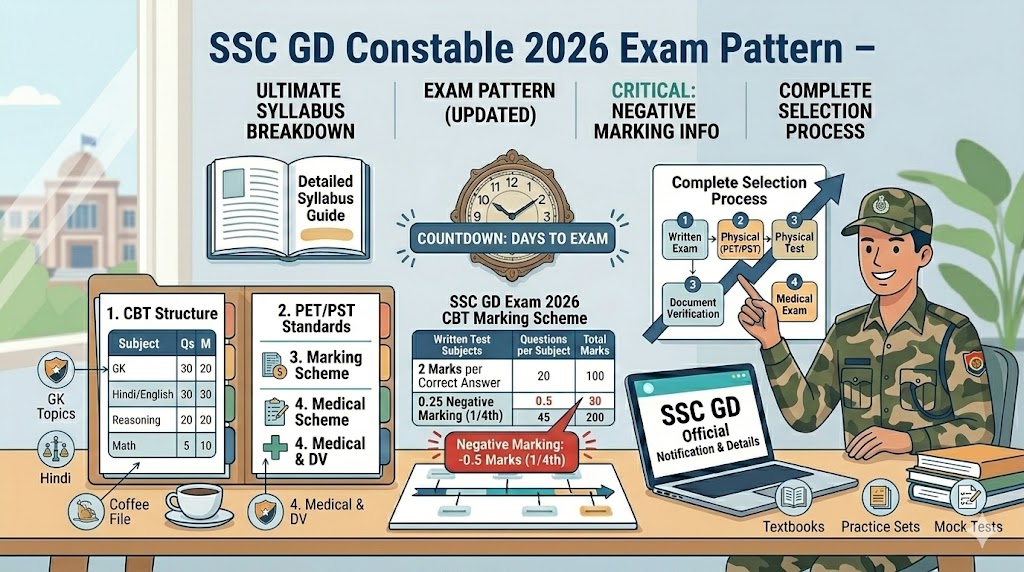
Marking Scheme
The negative marking is −0.25 per wrong answer — not 0.50. Since each question carries 2 marks, this is a 12.5% deduction on question value — significantly lower than SSC CGL’s proportional penalty.pw+1
What this means for your strategy:
The lower penalty fundamentally changes how aggressively you should attempt uncertain questions. With only 0.25 at risk against 2 marks to gain, the break-even point is much more favourable than in previous cycles. If you can eliminate even one option from four, attempt the question — the expected value is clearly positive. Only skip when you have absolutely zero basis for any judgment at all.
NCC Bonus Marks — Often Overlooked
Candidates holding NCC certificates receive bonus marks added to their CBE score:
-
NCC ‘C’ Certificate — 5% of maximum marks (8 marks)
-
NCC ‘B’ Certificate — 3% of maximum marks (4.8 marks)
-
NCC ‘A’ Certificate — 2% of maximum marks (3.2 marks)
This must be declared in the application form — you cannot claim it later.
Shortlisting for PET/PST
After CBE results, SSC calls candidates at 10 times the vacancies per force, per category, in merit order. If a force has 100 General category seats, the top 1,000 General CBE scorers get PET/PST calls. Everyone else is eliminated regardless of score.
CBE Section-wise Syllabus
General Intelligence and Reasoning (20 Questions)
Reasoning in SSC GD is straightforward — speed matters more than depth. A candidate who has practiced 30 reasoning questions daily for two months will finish this section in under 15 minutes, leaving more time for Mathematics.
General Knowledge and Awareness (20 Questions)
Current Affairs at 5–7 questions is the single highest individual topic count in GK. Government scheme launches, sports championships, awards, ISRO missions, and bilateral agreements from the last 6–8 months before the exam are the core sources.
Elementary Mathematics (20 Questions)
All questions are at Class 8–10 level. NCERT Class 8, 9, and 10 Maths textbooks cover the complete syllabus.
Percentage, Profit and Loss, and SI/CI together cover approximately 35–40% of Maths questions. Start here if your preparation time is limited.
English / Hindi Language (20 Questions)
Selected at application stage — cannot be changed after submission.
English: Reading comprehension — error spotting — fill in the blanks — synonyms and antonyms — one word substitution — idioms and phrases — sentence and spelling correction.
Hindi: गद्यांश पठन बोध — रिक्त स्थान पूर्ति — वर्तनी शुद्धि — वाक्य शुद्धि — मुहावरे और लोकोक्तियाँ — पर्यायवाची और विलोम — संधि और समास (basic level).
Choose based on genuine strength — not assumption. Most UP and Bihar aspirants score more confidently in Hindi.
Stage 2 — Physical Efficiency Test (PET)
The male standard of 5 km in 24 minutes = 4 minutes 48 seconds per kilometre. This is a sustained aerobic pace — not a sprint, not a jog. Three to four months of progressive running is the realistic preparation timeline. Train to finish in 22 minutes to build a genuine buffer, because nerves and unfamiliar tracks can add 1–2 minutes on PET day.
PET failure is the most common post-CBE elimination point in SSC GD. Start running the same week you start studying — not after results come out.
Note: Ex-servicemen are exempt from PET but must still undergo PST and the full Medical Examination.
Stage 3 — Physical Standard Test (PST)
Weight for all: proportionate to height per standard medical tables.
Force-specific relaxation: Candidates from certain hill and tribal areas may be eligible for a 5 cm height relaxation in specific forces. Check the official notification for force-wise details.
Height is a fixed biological measurement — there is no re-measurement or appeal for PST. If you do not meet the minimum, you are eliminated at this stage regardless of CBE score.
Stage 4 — Medical Examination
A Review Medical Examination (RME) is available if you dispute the DME result — conducted by a different medical board, and the RME outcome is final.
Candidates wearing glasses or contact lenses are typically disqualified for GD Constable posts. LASIK surgery is permitted for some forces but usually requires a minimum 1–2 year post-surgery period with no complications.
Stage 5 — Document Verification
Documents required at DV:
-
Class 10 certificate and marksheet
-
Caste certificate — SC/ST/OBC NCL in central government format (not state format)
-
OBC NCL certificate — current financial year only (expired = rejected)
-
EWS certificate — current financial year, competent authority
-
Domicile/PRC certificate matching the state indicated in your application
-
Aadhaar Card (original)
-
Character certificate
-
NOC from current government employer (if applicable)
-
Ex-serviceman discharge certificate (if applicable)
-
NCC certificate (if claiming bonus marks)
-
Passport photos — 6–8 copies
Most common DV rejection: OBC NCL in state format instead of central format, or certificate from the previous financial year. Get a fresh central format certificate well before DV.
Age Relaxation
Expected Cut-offs for CBE 2026
Based on SSC GD 2021 and 2023 trends — directional estimates only:
Targeting 130+ as a General candidate gives a realistic safety margin above the expected range.
4-Month Preparation Plan
Month 1 — Foundation
Lucent’s General Knowledge for History, Geography, Polity, Science. NCERT Class 9–10 Science. Start daily current affairs — monthly magazine or GK Today. NCERT Class 8–10 Maths for Percentage, Profit and Loss, SI/CI, Ratio, Average. Begin 2 km daily run.
Month 2 — Syllabus Completion
RS Aggarwal Reasoning — Analogy, Series, Coding, Blood Relations, Non-verbal. Language: grammar fundamentals and one comprehension passage daily. Maths: Time and Work, Speed-Distance, Mensuration, basic DI. Build to 3 km daily with interval sessions for pace.
Month 3 — Section Practice
Daily: 20 GK + 20 Reasoning + 20 Maths + 20 Language questions. Two section-wise mock tests per subject per week. Track wrong answers and identify recurring weak topics. Build to 5 km continuous three times per week.
Month 4 — Full Papers and Final Push
One complete 80-question CBE mock daily under 60-minute strict limit. With −0.25 negative marking, attempt aggressively — track any trend of careless errors rather than avoidance. Revise Current Affairs and static GK notes only in final two weeks. Achieve 5 km in under 23 minutes consistently before the PET date.
Recommended Resources
Direct Answers to Common Questions
Total questions and marks?
80 questions, 160 marks. Each correct answer = +2. Duration is 60 minutes
Is negative marking 0.25 or 0.50?
−0.25 per wrong answer for 2026 — confirmed across official sources. Since questions carry 2 marks each, this is a 12.5% deduction. Attempt aggressively when you can eliminate options.oliveboard+2
Does PET affect final rank?
No. PET is pass/fail only. Final rank is purely CBE-based. Failing PET ends your candidacy regardless of CBE score.
Can candidates from other states apply?
Yes, but vacancies are state/UT-wise — you apply under your domicile state’s quota and must produce a valid domicile certificate at document verification.
Minimum qualification?
Class 10 pass completed on or before 01-01-2026. Appearing candidates are not eligible.
Can PwD candidates apply?
No. SSC GD Constable is an active paramilitary combat role. PwD candidates are not eligible to apply.
When does PET/PST happen?
Approximately 3–4 months after CBE results based on previous cycles. Do not wait for results to begin physical training.
Always verify notification details at ssc.gov.in — vacancy numbers, exact dates, and force-specific standards are subject to official updates.
This website is independent and not affiliated with SSC or any government body. Content is for educational and informational purposes only.
Written by Manish | Government exam preparation | sarkariexamresults.net
2 thoughts on “SSC GD Constable 2026 – Exam Pattern, Selection Process”