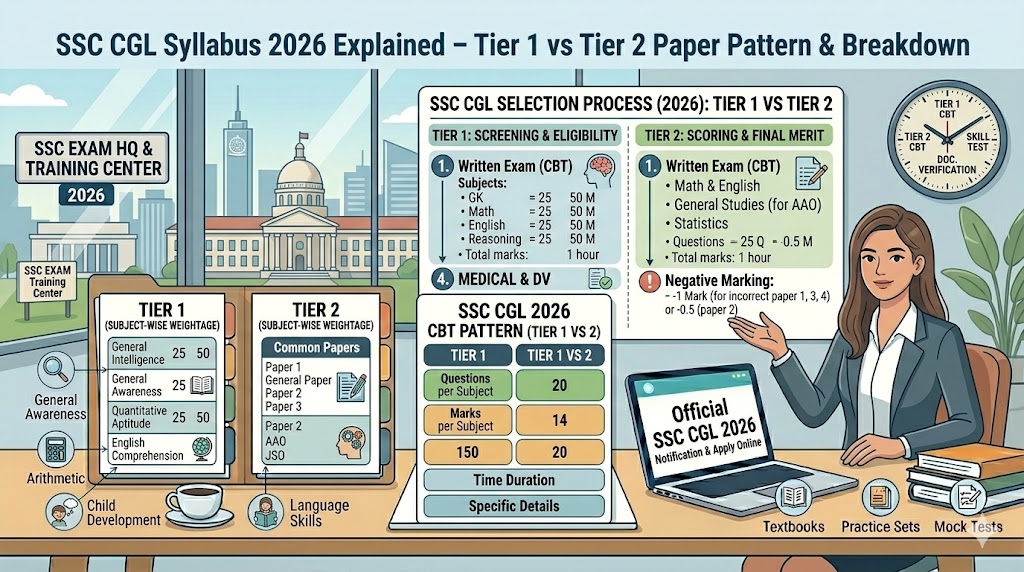
The SSC CGL 2026 notification is expected this week — originally scheduled for March 31, 2026, it was slightly delayed and is now imminent in the first week of April 2026, with Tier 1 exam expected May–June 2026. If you have been waiting to start preparation, that window has effectively closed. If you are already preparing, the exam is 6–8 weeks away.adda247+1
The single most important structural fact to understand before preparing: Tier 1 does not count in your final merit list. Tier 1 only shortlists you for Tier 2 — your actual selection rank is decided entirely by Tier 2 marks. Candidates who optimise for Tier 1 at the expense of Tier 2 are optimising for the wrong objective.
Exam Structure — Two Tiers, One Merit Stage
Paper III (Finance and Economics) has been discontinued — Tier 2 now consists of Paper I (compulsory) and Paper II (Statistics, specific posts only). Any guide or resource that still lists Paper III as a current requirement is working from an outdated syllabus.
SSC CGL 2026 — Key Dates
The SSC CGL 2025 cycle Tier 2 was conducted January 18–19, 2026. The cycle currently underway is SSC CGL 2026 — a new recruitment cycle with its own application, Tier 1, and Tier 2.
Tier 1 — Exam Pattern
All four sections are attempted in the same 60-minute window — no section is locked or timed independently. Time management is therefore the primary Tier 1 skill: most well-prepared candidates target completing Reasoning in 15 minutes, GK in 8 minutes, Maths in 18 minutes, and English in 12 minutes, leaving 7 minutes for review.
Tier 1 Syllabus — Section by Section
General Intelligence and Reasoning — 25 Questions, 50 Marks
The most consistently scorable section with structured daily practice.
Non-verbal Reasoning (mirror image, embedded figures, paper folding) consistently accounts for 3–4 questions and requires visual pattern practice — theory reading alone is insufficient.
General Awareness — 25 Questions, 50 Marks
The least predictable section — questions can come from any static GK domain or current affairs topic.
Current affairs (5–7 questions) and General Science (4–6 questions) together account for nearly half this section. Do not attempt to cover all of history and geography equally — focus on current affairs, science, and constitution-polity topics which SSC repeats predictably.
Quantitative Aptitude — 25 Questions, 50 Marks
Class 10–12 level. Not engineering mathematics — speed and accuracy in applied arithmetic is what is tested.
English Language and Comprehension — 25 Questions, 50 Marks
Tested at graduation level — vocabulary depth and grammatical precision matter more than general comprehension.
Reading comprehension (one passage, 4–5 questions), error spotting, sentence improvement, fill in the blanks, synonyms and antonyms, idioms and phrases, one-word substitution, spelling correction, active and passive voice, para jumbles, cloze test, direct and indirect speech.
Tier 2 — Exam Pattern
Paper I — Compulsory for All Candidates
Paper I is conducted in two sessions on the same day:
Session I — 2 Hours (Scored):
Session II — 30 Minutes (Qualifying):
Negative Marking in Paper I:
-
Section I, Section II, and Module I of Section III: 1 mark per wrong answeradda247+2
-
This is double the Tier 1 penalty — a wrong answer in Tier 2 Maths (3 marks per question) costs you 1 mark net, not 0.5
Computer Knowledge Test: Qualifying only — minimum 20% (12 out of 60 marks) required.
DEST (Data Entry Speed Test): Qualifying — 2000 key depressions in 15 minutes. Applicable for DEO-type posts; candidates for non-typing posts are exempt.
Tier 2 Syllabus — Section by Section
Section I, Module I — Mathematical Abilities (30 Questions, 90 Marks)
Tier 2 Maths is significantly harder than Tier 1. Multi-step problems dominate, and Algebra, Geometry, and Trigonometry carry disproportionately high weightage.
Complete topic list:
-
Number System — divisibility rules, unit digits, remainders, LCM, HCF, surds and indices
-
Percentage, Profit and Loss, Discount
-
Ratio and Proportion, Partnership, Mixture and Alligation
-
Average
-
Simple Interest and Compound Interest
-
Time and Work, Pipes and Cisterns
-
Time, Speed and Distance (Trains, Boats, Races)
-
Algebra — identities, linear equations, quadratic equations, polynomials, surds and indices
-
Geometry — congruence and similarity, circles (arc, chord, tangent, secant, cyclic quadrilateral), triangles and quadrilaterals
-
Mensuration — 2D (area and perimeter of all standard shapes); 3D (volume and surface area of cube, cuboid, cylinder, cone, sphere, hemisphere)
-
Trigonometry — standard values, identities, complementary angles, height and distance applications
-
Statistics — mean, median, mode, standard deviation, histogram, frequency polygon
-
Data Interpretation — tables, bar graphs, pie charts, line graphs, comparative data
Priority cluster: Algebra + Geometry + Trigonometry + Mensuration together account for approximately 40–45% of all Tier 2 Maths questions — this cluster is non-negotiable.
Section I, Module II — Reasoning and General Intelligence (30 Questions, 90 Marks)
Same topic areas as Tier 1 but at greater depth and with more complex multi-step patterns:
-
Verbal reasoning — analogy, classification, series (with more complex rule structures than Tier 1)
-
Coding-decoding — multi-code complex patterns
-
Logical reasoning — Venn diagrams, syllogisms, statement-assumption-conclusion
-
Non-verbal reasoning — pattern completion, paper folding, figure matrix
-
Critical thinking — cause-effect, assertion-reason
-
Data sufficiency
-
Word and number arrangement problems
Section II, Module I — English Language and Comprehension (45 Questions, 135 Marks)
English carries the highest marks of any section in Tier 2 Paper I — 135 out of 390 total scored marks (35%). It is the single most important section for merit ranking.
Tier 2 English is markedly harder than Tier 1:
-
Reading Comprehension: 3 passages of 300–500 words each, 5–7 questions per passage — tests inference, tone identification, and vocabulary in context (not just surface comprehension)
-
Cloze Test: Passage with multiple blanks requiring vocabulary precision
-
Error Spotting: Complex sentences with subtle grammatical errors in subordinate clauses, agreement, and tense
-
Sentence Improvement: Multi-option revisions testing both grammar and register
-
Para Jumbles: 5–6 sentence reordering for logical and thematic flow
-
Synonyms and Antonyms: Advanced vocabulary — not common everyday words
-
Idioms and Phrases: Tested in context with decoy options
-
Active and Passive Voice: Complex tense structures across multiple clauses
-
Direct and Indirect Speech: Complex sentences with tense shifts
-
One-Word Substitution, Fill in the Blanks (including double-blank questions)
The vocabulary gap between Tier 1 and Tier 2 English is significant. Candidates who rely only on common-word synonyms and basic grammar rules consistently underperform in Tier 2 English.
Section II, Module II — General Awareness (25 Questions, 75 Marks)
Same domains as Tier 1 GA but questions are deeper and more specific — tested at a level that requires conceptual understanding, not just fact recall:
-
Current Affairs (last 6–8 months — events, government schemes, appointments, international summits, sports)
-
History of India (Ancient, Medieval, Modern — with emphasis on cultural history and landmarks alongside political events)
-
Geography (physical, economic, and political — India and World)
-
Indian Polity and Constitution — specific articles, schedules, constitutional amendments, landmark Supreme Court judgements
-
Economics — GDP, inflation types, monetary and fiscal policy, RBI instruments, budget terminology, Five Year Plans
-
General Science — Physics, Chemistry (periodic table, reactions), Biology (human body, diseases, ecology)
-
Static GK — important days, national symbols, first persons in India
Section III, Module I — Computer Knowledge Test (20 Questions, 60 Marks — Qualifying)
Minimum 20% qualifying marks required — designed as a basic literacy check:
-
Basics of computers — input/output devices, storage types, CPU, RAM vs ROM
-
Operating systems — Windows basics, file management
-
MS Office — Word processing, spreadsheet basics, presentation concepts
-
Internet — browsers, email, basic networking (LAN, WAN, IP address)
-
Common abbreviations — CPU, RAM, ROM, USB, HTML, HTTP, URL, BIOS
-
Cybersecurity basics — virus, firewall, antivirus concepts
Tier 2 — Paper II: Statistics (100 Questions, 200 Marks)
Paper II is only for Junior Statistical Officer (JSO) posts under the Ministry of Statistics (MoSPI). Negative marking: 0.50 marks per wrong answer.careerpower+1
Duration: 2 hours.
Topics:
-
Collection and representation of data — frequency tables, graphs
-
Measures of central tendency — mean, median, mode for ungrouped and grouped data
-
Measures of dispersion — range, quartile deviation, mean deviation, standard deviation
-
Moments, skewness, and kurtosis
-
Correlation and regression — Karl Pearson’s coefficient, Spearman’s rank correlation
-
Probability theory — classical probability, conditional probability, Bayes’ theorem
-
Random variables and probability distributions — Binomial, Poisson, Normal distributions
-
Sampling theory — random, stratified, systematic, cluster sampling; sampling errors
-
Statistical inference — point and interval estimation, hypothesis testing (Z-test, t-test, chi-square test, F-test)
-
Analysis of Variance — one-way and two-way ANOVA
-
Time series analysis — components, trend analysis methods
-
Index numbers — Laspeyre’s, Paasche’s, and Fisher’s index
Paper II is degree-level Statistics — candidates for JSO posts need a genuine command of probability distributions and statistical inference, not just basic descriptive statistics.
Tier 1 vs Tier 2 at a Glance
Post-wise Paper Requirements
Paper III (Finance and Economics) is discontinued — AAO/Audit Officer candidates now require only Paper I.
Qualifying Marks
These are the floor qualifying marks — actual competitive cut-offs are substantially higher, particularly in Tier 2 English and Maths.
Preparation Strategy — By Time Available
If You Have 6–8 Weeks (Tier 1 Cycle)
Weeks 1–2: Maths and Reasoning sprint
Revise the five Tier 1 Maths priority topics (Algebra, Geometry, Trigonometry, Percentage, Time-Work-Distance) from a single standard source. 30 Reasoning questions daily — both verbal and non-verbal.
Weeks 3–4: English and GK
English: Daily 1 reading comprehension passage + 15 grammar questions (error spotting and sentence improvement). Vocabulary: 10 idioms and 5 one-word substitutions daily. GK: Complete current affairs for the preceding 6 months; revise Static GK notes from a single standard source.
Weeks 5–6: Full Tier 1 Mock Tests
Two complete timed Tier 1 mock papers daily — strict 60-minute limit. After each test, categorise wrong answers by topic and re-study from source, not just from solution keys. Track your time distribution across sections — adjust target times if one section is consistently exceeding budget.
Weeks 7–8: Weak topic intensive + Tier 2 Preview
Intensive revision of the 3 topics where you are losing most marks. Begin familiarising yourself with Tier 2 Paper I English passage style and Tier 2 Maths difficulty level — you have weeks between Tier 1 and Tier 2, not months.
If You Have 6–12 Months (Full Cycle)
Months 1–3 — Foundation
NCERT Class 9–12 Maths — complete Algebra, Geometry, Trigonometry, Mensuration, and Statistics chapters. Build English vocabulary with 10 new words daily from a standard GRE/SSC word list — this is the single highest-ROI long-term activity for SSC CGL. Begin daily newspaper reading for current affairs. 20 Reasoning questions daily.
Months 4–6 — Syllabus Completion
Complete all Tier 1 and Tier 2 Maths topics from a standard SSC CGL book (Rakesh Yadav or R.S. Aggarwal). Complete English grammar — error spotting patterns, voice, speech, para jumbles. Build Static GK from a standard SSC GK book. Attempt 2 Tier 1 section-wise tests per week.
Months 7–9 — Speed and Previous Year Papers
Solve 10 previous year Tier 1 papers (2018–2025) — complete papers, strict timing. Solve 5 previous year Tier 2 Paper I papers (Session I). Identify your 3 weakest topics across all sections and build an intensive revision plan targeting specifically those topics.
Months 10–12 — Mock Tests and Final Revision
Three full Tier 1 mock tests per week. Two full Tier 2 Paper I mock tests per week. Review every wrong answer — understand the underlying concept, not just the correct option. Final month: revise formula sheets, vocabulary lists, static GK summaries, and current affairs only — no new topics.
Recommended Resources
Common Questions Answered Directly
Does Tier 1 count in the final merit list?
No — Tier 1 is purely qualifying. It shortlists approximately 20 times the number of vacancies for Tier 2. Final rank is decided entirely by Tier 2 Paper I (and Paper II for JSO posts).
What is the negative marking structure?
Tier 1: 0.50 marks per wrong answer. Tier 2 Paper I (Sections I and II and Computer Knowledge): 1 mark per wrong answer. Tier 2 Paper II (Statistics): 0.50 marks per wrong answer.practicemock+3
Is Paper III still part of SSC CGL?
No — Paper III (Finance and Economics) has been discontinued. Tier 2 now comprises only Paper I (compulsory for all) and Paper II (Statistics, JSO posts only).
Which section carries the most marks in Tier 2?
English Language and Comprehension — 45 questions worth 135 marks — carries 35% of all scored Tier 2 Paper I marks. It is the highest-priority section for merit ranking.
When is SSC CGL 2026 notification releasing?
Expected in the first week of April 2026 — originally scheduled March 31 but slightly delayed. Tier 1 exam expected May–June 2026.careerpower+2
What are the highest-paying posts through SSC CGL?
Assistant Audit Officer (CAG), Inspector of Income Tax, Inspector of Central Excise, and Assistant Section Officer in MEA are among the most sought-after — typically at Pay Level 7 or 8 in the 7th CPC pay matrix.
Exam pattern, syllabus, and vacancy details are subject to change per official SSC notification. Always verify from ssc.gov.in before preparing or applying.
This website is independent and not affiliated with Staff Selection Commission or the Government of India. Content is for educational and informational purposes only.
Written by Manish | Government exam preparation | sarkariexamresults.net
1 thought on “SSC CGL Syllabus 2026 – Tier 1 vs Tier 2 Pattern, Topic-wise Weightage & Complete Preparation Guide”