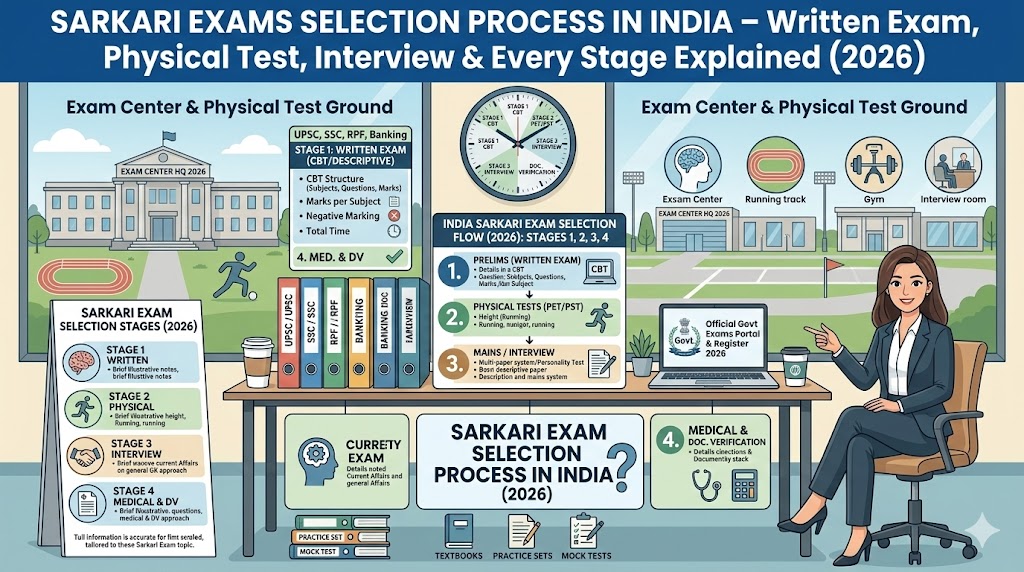
Most government job aspirants fail not at the written exam, but at stages they barely prepared for. Document Verification eliminates candidates with expired caste certificates. Physical tests eliminate candidates who spent all their time studying and none of it running. Medical exams end careers of candidates who did not know colour blindness disqualifies them for the post they applied for.
Understanding the complete selection process — not just the written exam — is preparation. This guide covers every stage, what it tests, how it scores, and where candidates are actually eliminated.
The Universal Framework
Almost every government recruitment in India follows the same seven-stage framework, though not all exams use all stages:
Which stages apply depends entirely on the post category:
Stage 1 — Preliminary Examination
The preliminary exam — also called Tier 1, CBT 1, Phase 1, or Prelims — is a screening filter, not a merit-ranking stage. Its purpose is to reduce an applicant pool of millions to a manageable shortlist that proceeds to Mains.
Key characteristics:
-
Objective type (MCQ) — faster to evaluate at scale
-
Time limited — typically 60 to 120 minutes
-
Marks are not counted in the final merit list for most exams — qualifying/shortlisting function only
-
Negative marking applies in most exams — 0.25 to 0.50 marks per wrong answer
-
Cut-off varies by category (General / OBC / SC / ST) and by year
Prelims Across Major Exams
UPSC CSAT important note: In UPSC Prelims, CSAT (Paper II) is qualifying only — you need 33% (66 out of 200 marks) to clear it. Your General Studies Paper I score alone determines whether you are shortlisted for Mains. Many aspirants do not know this and over-invest in CSAT preparation at the cost of GS Paper I.
Common mistakes at the Prelims stage:
-
Over-attempting when negative marking applies — reckless guessing causes more eliminations than lack of preparation
-
Not studying previous year cut-off trends — exam difficulty varies yearly and past cut-offs help calibrate how many questions to attempt
-
Assuming the same negative marking formula applies across exams — SSC uses 0.50, Railway uses 0.33, Banking uses 0.25
Stage 2 — Main Examination
The Mains is the primary merit-forming examination. Mains marks are counted in the final merit list — this is where your actual selection rank is determined.
Type A — Objective / MCQ-based Mains
Used by SSC, Railways, Banking clerks, and State Police written exams. Same MCQ format as Prelims but harder, with more questions or more subjects. Negative marking continues. Marks directly form the merit list.
Type B — Descriptive / Essay-based Mains
Used by UPSC CSE, State PCS (UPPSC, BPSC, MPSC, RPSC), and SBI PO Mains. Multiple lengthy papers with essay, précis writing, and comprehension. Tests depth of analytical thinking and writing ability. Evaluated by human examiners — word limits, argument structure, and answer presentation all matter. Typically no negative marking in descriptive papers.
UPSC Civil Services Mains — 9 Papers
UPSC CSE 2026 Mains is scheduled from August 21, 2026, for five days.vajiramandravi+1
SSC CGL Tier 2 — CBT Mains
Stage 3 — Physical Efficiency Test (PET) and Physical Standard Test (PST)
Physical tests apply to Police, Paramilitary, Railway Protection Force, and Defence posts where physical fitness is a functional job requirement.
Physical Efficiency Test (PET) — Running and Endurance
PET is qualifying — pass or fail. Marks are not added to the final merit list. The purpose is to filter out candidates who cannot meet the minimum physical requirement of the role.
Why candidates fail PET despite clearing written exam: Gym fitness and timed distance running fitness are different. A candidate who lifts weights daily can still fail a 5 km timed run if they have not trained specifically for aerobic running endurance. Start running training 3 months before the expected PET date — not after the written result arrives.
Physical Standard Test (PST) — Height, Chest, Weight
PST measures anthropometric standards — fixed biological dimensions that cannot be changed.
SSC GD Constable PST Standards:careerpower+1
PST is qualifying only. Height-related disqualification cannot be challenged on appeal — these are fixed measurement standards, not discretionary evaluations.
Stage 4 — Skill Test and Typing Test
Skill tests assess functional job skills directly — they are separate from written exams and used for clerical, steno, and data entry posts.
Typing Test
Typing tests are qualifying in nature — you either meet the minimum speed or you don’t. Candidates must practice on the same keyboard type and font (English QWERTY; Hindi Kruti Dev or Mangal Unicode) that will be used in the actual test. These are specified in the admit card.
Stenography Test
Dictation is read at the specified speed — candidates take shorthand notes and transcribe on a computer within the allotted time. Both speed and accuracy affect outcome; uncorrected transcription errors directly reduce the effective performance.
Computer Proficiency Test (CPT)
Used for Tax Assistant and similar posts in SSC CGL. Tests word processing (MS Word-type), spreadsheet usage (MS Excel-type), and presentation creation (MS PowerPoint-type). Qualifying in nature — minimum passing marks required. Daily practice on actual MS Office software, not theoretical study of its features.
Data Entry Speed Test (DEST)
Used for Data Entry Operator posts in SSC. Requirement: 2000 key depressions in 15 minutes on a computer. Qualifying in nature.
Stage 5 — Interview and Personality Test
Not all government jobs include an interview. Understanding which posts do and do not have interviews is critical preparation planning knowledge.
Group B and C Posts — No Interview (Since 2016)
Following a Government of India directive in 2016, all non-gazetted (Group B and C) central government posts no longer have an interview round. This covers:
-
All SSC posts (CGL, CHSL, GD, MTS)
-
All Railway RRB/RRC posts (NTPC, Group D, ALP)
-
Most State Police constable and head constable posts
-
Banking clerk-level posts (IBPS Clerk, SBI Clerk)
For all these posts, final merit is based entirely on written exam marks plus any qualifying skill tests.
Group A and Gazetted Posts — Interview Retained
UPSC Civil Services Personality Test (Interview)
UPSC Prelims 2026 is scheduled May 24, 2026 and Mains from August 21, 2026 — with 933 vacancies notified.vajiramandravi+1
What the UPSC interview actually assesses: The UPSC explicitly states this is not a knowledge test. The board looks for mental alertness, critical powers of assimilation (absorbing new information and forming a rapid reasoned view), clear logical exposition of thinking, balance of judgment, variety and depth of genuine intellectual interests, leadership potential, and awareness of and commitment to national interest.
The DAF (Detailed Application Form) — your hobbies, hometown, educational background, optional subject, previous experience — is read in full by the interview board before you enter the room. Every answer you gave in your DAF is a potential interview question. Prepare it thoroughly and honestly, because inconsistency between your DAF and interview responses is visible to experienced panelists.
Bank PO Interview (IBPS PO / SBI PO)
-
Marks: 100 marks for interview
-
Final merit weightage: Mains (80%) + Interview (20%)
-
Duration: 15–20 minutes with a bank panel
-
What is assessed: Communication skills, banking and financial awareness, analytical ability, and motivation for banking as a career
State PCS Interviews (UPPSC, BPSC, MPSC, RPSC)
All State PSC higher-service exams have a Personality Test similar in format to UPSC. Mark weightage varies — UPPSC carries 100 marks, BPSC carries 120 marks. State-specific current affairs and regional awareness are additionally important in State PCS interviews.
Stage 6 — Document Verification (DV)
Document Verification is the stage where your eligibility on paper is physically checked against original certificates. It is qualifying — you either have the correct documents or you don’t. It eliminates a significant number of candidates who cleared every earlier stage.
What Is Verified
Top Reasons for Rejection at DV
Expired OBC NCL certificate. This is the single most common DV rejection cause for central government posts. OBC Non-Creamy Layer (NCL) certificates must be issued in the current financial year or the immediately preceding financial year for most central government recruitments. A certificate from more than one year ago is typically invalid.
Wrong certificate format. Central government posts require caste certificates in the central government prescribed format — not state government format. Candidates from UP, Bihar, MP, and other states routinely submit state-format OBC certificates for SSC, Railway, and Bank posts, resulting in rejection. The formats are different documents and must be obtained separately.
The OBC NCL income criterion — the critical nuance. The income threshold for OBC Non-Creamy Layer status is ₹8 lakh per annum of parental income. However — and this is where most guides are incomplete — salary income for government employees and agricultural income are excluded from this ₹8 lakh calculation under the central government rules. A parent who is a government employee earning ₹10 lakh as salary, with no other income source, may still qualify their child for OBC NCL status — because salary income is not counted toward the ₹8 lakh limit. The Supreme Court reaffirmed this distinction in its March 2026 clarification. Verify your specific case with a competent authority before applying.clearias+3
Degree certificate without convocation. Provisional certificates from some universities are not accepted. A proper convocation-issued degree certificate is required at DV — provisional marksheets alone may not suffice.
Name mismatch between application and documents. A difference between “Manish Kumar” on the application and “Manish Kumar Sharma” on the marksheet — even a missing middle name — triggers a verification challenge that requires additional affidavits and delays.
Missing NOC. Government employees who applied without employer knowledge often cannot produce a No Objection Certificate in time.
Golden rule: Arrange every document — especially caste certificates and income certificates — before the written exam, not after the result. In UP and Bihar districts, caste certificates take 2–4 weeks to obtain. Income certificates for EWS require assessment from a revenue officer. Do not assume these can be arranged in the 2–3 weeks between result and DV.
Stage 7 — Medical Examination
The medical exam applies to posts where physical fitness is a direct job function — Police, Paramilitary, Defence, Railway, and similar roles.
What the Medical Exam Tests
Vision Standards — Where Candidates Most Commonly Fail
On LASIK surgery: Many central government notifications now permit LASIK-corrected vision, but require a minimum waiting period of 12–24 months post-surgery with no residual complications. Check the specific recruitment notification — the rule varies by force and post. Do not assume LASIK automatically qualifies you.
Colour blindness is a disqualifying condition for Track Maintainer, Point Man, Signal Technician, and most Police/Paramilitary GD posts — these roles require reading colour-coded signals and equipment. Candidates with colour blindness should verify which specific posts they remain eligible for before investing years in preparation for a post they cannot be appointed to.
DME vs RME
-
DME (Detailed Medical Examination): Mandatory for all candidates reaching the medical stage
-
RME (Review Medical Examination): Optional appeal — if a candidate believes the DME result was incorrect, they can request RME within the stipulated period, conducted by a different medical board
-
RME result is final — no further appeal is permitted after RME
Final Merit List — How Selection Rank Is Determined
The final merit formula is fixed and publicly notified in the recruitment advertisement. No stage result can compensate for weakness at a merit-forming stage. A top interview performance cannot offset a weak Mains score; a strong written exam cannot override a medical failure.
Commonly Misunderstood Rules
“Cleared the written exam” does not mean “selected.” In all constabulary, paramilitary, and Railway Group D exams, only CBE marks form the merit — but PET, PST, and Medical eliminate candidates who came with top written scores. Clearing the written exam gives you the right to appear for subsequent stages; it does not guarantee appointment.
OBC NCL certificate validity for central government posts. The certificate must be recent — current or immediately preceding financial year for most central government posts. The ₹8 lakh income threshold excludes salary income of government employees and agricultural income when calculating parental income. If your parent is a government employee, their salary alone does not count toward the ₹8 lakh ceiling.drishtiias+2
Ex-serviceman age relaxation applies only at the eligibility stage. Age relaxation determines whether you can apply. It does not relax physical standards, medical standards, or PET/PST requirements — those standards are the same for all applicants regardless of age relaxation eligibility.
PwD exemption from PET/PST. Persons with Disabilities are typically exempt from PET and PST in Police and Paramilitary recruitment. Their physical assessment is replaced with a medical suitability check aligned with the nature of their disability.
Documents cannot be substituted retroactively. If your OBC NCL certificate is in state format at DV, you cannot present a new central-format certificate on the spot. The DV is done on the documents you submit — deficient documents result in rejection from that recruitment cycle.
Exam-Specific Selection Overviews
UPSC Civil Services (IAS/IPS/IFS) — 933 Vacancies
-
Prelims (May 24, 2026): GS Paper I (200 marks, merit) + CSAT Paper II (200 marks, qualifying — need 66)
-
Mains (August 21, 2026): 9 papers — 2 qualifying language papers + 7 merit papers (1750 total)
-
Personality Test (Interview): 275 marks, 30–45 minutes, 5-member panel
-
DV + Medical
-
Total merit marks: 2025
SSC CGL
-
Tier 1 (Prelims): 100 questions, 200 marks — shortlisting only
-
Tier 2 (Mains): 390 scored marks + qualifying computer/skill module
-
Skill Test: CPT/DEST/Typing — qualifying, post-dependent
-
DV: Final stage. No interview for any post.
RRB NTPC
-
CBT 1: 100 marks — shortlisting (20 times vacancies)
-
CBT 2: Merit-forming (120 questions)
-
CBAT (Station Master / Traffic Assistant only): Aptitude test — qualifying
-
Typing / Skill Test: For clerical posts — qualifying
-
DV + Medical
Bank PO (IBPS / SBI PO)
-
Prelims: 100 marks — qualifying
-
Mains: 200 marks (MCQ) + 25 marks (Descriptive) = 225 marks
-
Interview: 100 marks (final merit: 80% Mains + 20% Interview)
-
DV
Bank Clerk (IBPS / SBI Clerk) — No Interview
-
Prelims: Qualifying
-
Mains: Merit-forming
-
DV
Defence — NDA and CDS
-
Written Exam (UPSC-conducted): NDA: Mathematics + General Ability. CDS: English + GK + Maths
-
SSB Interview (5 days):
-
Stage I (Day 1): OIR Test + PPDT (Picture Perception and Discussion Test)
-
Stage II (Days 2–5): Psychology tests, Group Tasks (GTO), and Personal Interview
-
The SSB tests 15 Officer Like Qualities (OLQs) including courage, initiative, intelligence, self-confidence, and social adaptability
-
-
Medical Examination: At Armed Forces hospitals — strict vision and physical fitness standards
-
DV + Training: IMA, INA, AFA, or OTA depending on service selected
Common Questions Answered Directly
Which government exams have no interview?
All SSC posts, all Railway RRB/RRC posts, most State Police constable posts, and IBPS/SBI Clerk posts eliminated interviews following the 2016 Government of India directive. Interviews are retained only for gazetted officer posts — IAS/IPS, Bank PO, State PCS officers, and defence commissions.
Is PET qualifying or does it add marks?
PET is qualifying for all central government exams (SSC GD, RPF, UP Police, Railway Group D). You must pass it but no marks are added to the final merit list.
Can I clear a medical failure through appeal?
Candidates declared medically unfit at DME can request a Review Medical Examination (RME) — conducted by a different medical board. The RME result is final; no further appeal is allowed after RME.
What is the most common DV rejection reason?
Expired OBC NCL certificate and submission of a state-format caste certificate for a central government post are the two most common causes. Both can be prevented with advance preparation — arrange documents at least 4–6 weeks before you expect to need them.
Is LASIK-corrected eyesight accepted?
Many recruitments now permit LASIK-corrected vision with conditions — typically 12–24 months post-surgery waiting period and no complications. Verify from the specific force’s notification; the rule is not uniform across all recruitments.
How is the UPSC final rank calculated?
Mains (1750 marks) + Personality Test (275 marks) = 2025 marks total. Prelims marks are not counted. The Personality Test carries approximately 13.6% of total merit marks.
Selection process details, physical standards, and medical criteria are subject to change per individual recruitment notification. Always verify from the official recruiting body’s notification before preparing or applying.
This website is independent and not affiliated with UPSC, SSC, Railway, or any government body. Content is for educational and informational purposes only.
Written by Manish | Government exam preparation | sarkariexamresults.net