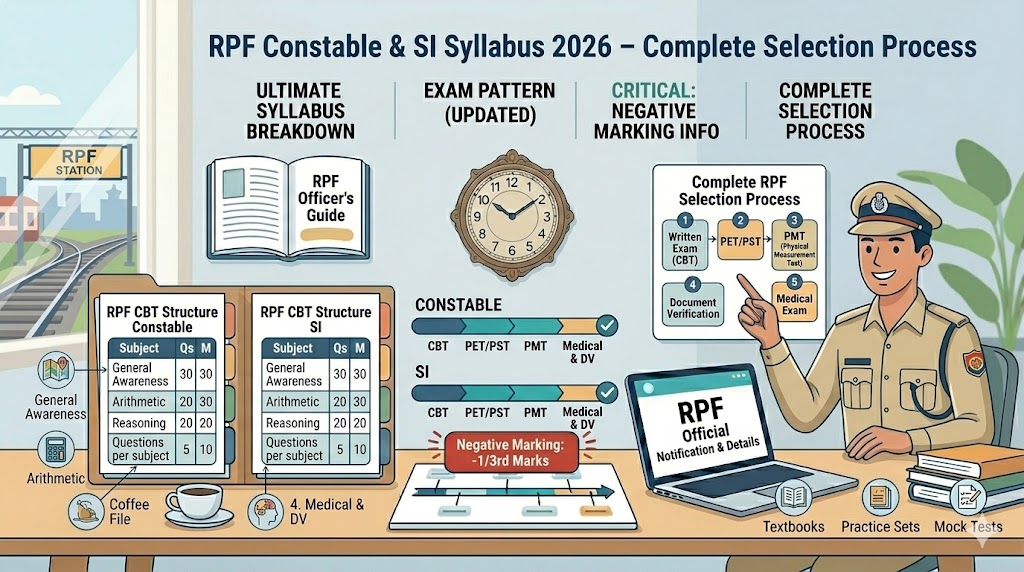
Railway Protection Force is not just another government job. It is a uniformed service under Indian Railways — with railway quarters, travel allowances, zone-wise postings, and a career structure that very few central government jobs match at Class 12 or graduation entry level.
Two things define this recruitment that most guides gloss over. First, General Awareness is 41.6% of the entire paper — yet it is the most underprepared section among RPF aspirants, most of whom pile time into Reasoning and Arithmetic.
That imbalance directly costs marks. Second, clearing the written exam does not mean selection — physical training must run parallel to CBT preparation from day one, not begin after results come out.
This guide covers both Constable and SI in one place — the differences in difficulty, physical standards, and eligibility are clearly separated throughout.
Two Posts, One Framework
Selection — Four Stages, One That Decides Your Rank
Your rank is permanently set after Stage 1. Stages 2 through 4 are gates — they confirm physical and documentary eligibility, but add nothing to your score. A higher CBE scorer who fails the height check is eliminated. A lower scorer who clears all physical stages gets selected. Both parts of this process deserve equal preparation attention.
CBT Pattern — Same Structure, Different Depth
Duration: 90 minutes — 45 seconds per question average.
Negative marking: 1/3 mark (0.33) per wrong answer.adda247+1
Mode: Computer-based, online.
Medium: English, Hindi, or regional language.
No sectional time limit — attempt in any order.
Normalisation applied across multiple shifts.
The CBT structure is identical for Constable and SI. The difference is entirely in question depth — SI tests Economics, Governance, and Arithmetic at graduation level. GA content and Reasoning framework remain the same across both posts.
Understanding the 1/3 Negative Marking
Each question is worth 1 mark. A wrong answer costs 0.33 marks. This is a 33% deduction on question value — meaningfully harsher than SSC GD’s 0.25 penalty or UP Police’s zero penalty.
The practical implication: you need three correct answers to recover the ground lost by one wrong answer. This is not a regime where aggressive guessing pays off.
The right approach:
-
Attempt confidently when you know the answer or can eliminate two options
-
Skip entirely when you have no factual basis for any choice
-
Never guess randomly — the 1/3 penalty makes purely speculative attempts a net negative over time
Section 1 — General Awareness (50 Questions, 50 Marks)
50 marks out of 120 — that is 41.6% of the entire paper sitting in one section. A candidate with solid GK preparation can answer these 50 questions in 20–25 minutes, leaving more time for Arithmetic where calculation is involved. Most candidates get this backwards, spending 35+ minutes on Maths and rushing through GK.
History (8–10 Questions)
Ancient India:
-
Indus Valley Civilisation — sites (Harappa, Mohenjo-daro, Lothal, Kalibangan), features, decline
-
Vedic Period — Rigvedic society, later Vedic developments
-
Maurya Empire — Chandragupta Maurya, Ashoka’s Dhamma, Rock Edicts
-
Gupta Empire — Golden Age achievements in art, science, literature
-
Buddhism and Jainism — Four Noble Truths, Eightfold Path, Mahavira’s doctrines
Medieval India:
-
Delhi Sultanate — Qutub-ud-din Aibak, Alauddin Khilji, Muhammad bin Tughluq
-
Mughal Empire — Akbar’s Navratnas, Din-i-Ilahi, land revenue system; Aurangzeb; decline
-
Bhakti and Sufi movements — Kabir, Mirabai, Guru Nanak, Ramananda
-
Vijayanagara and Bahamani kingdoms — basics
Modern India:
-
British expansion — East India Company, Subsidiary Alliance, Permanent Settlement, drain of wealth
-
Revolt of 1857 — causes, key centres, major leaders, outcome
-
Indian National Congress — formation, moderates vs extremists
-
Gandhi-led movements — Non-Cooperation (1920), Civil Disobedience (1930), Quit India (1942)
-
Bhagat Singh and Subhas Chandra Bose — roles
-
Partition and Independence (1947)
RPF-specific History: Indian Railways history appears regularly in RPF GA papers and nowhere else — first train in India (1853, Bombay to Thane), formation of RPF, railway milestones. These are free marks for candidates who prepare them deliberately.
Geography (7–8 Questions)
-
Physical features — Himalayas, Indo-Gangetic Plains, Deccan Plateau, Eastern and Western Ghats
-
Major rivers — Ganga, Yamuna, Brahmaputra, Godavari, Krishna, Kaveri; tributaries and drainage
-
Climate — monsoon mechanism, four seasons, cyclone patterns
-
Soil types — alluvial, black/regur, red laterite
-
Natural vegetation zones — tropical rainforest, deciduous, thorn, alpine
-
National Parks — Project Tiger, Project Elephant; major reserves
-
Minerals — coal (Jharkhand), iron ore (Odisha), petroleum (Assam, Gujarat)
-
World geography basics — continents, major mountain ranges, rivers, deserts
Indian Polity (6–7 Questions)
-
Preamble — key words and significance
-
Fundamental Rights (Articles 12–35) — key rights and exceptions
-
Fundamental Duties (Article 51A)
-
DPSP — important directives
-
Parliament — Lok Sabha and Rajya Sabha composition and powers
-
President and Prime Minister — election, roles, constitutional position
-
Judiciary — Supreme Court, High Courts, judicial review, writ jurisdiction
-
Election Commission — EVMs, Model Code of Conduct
-
Panchayati Raj — 73rd Amendment, three-tier structure
-
Emergency provisions — Articles 352, 356, 360
Economics (5–6 Questions)
-
Basic terminology — GDP, GNP, NNP, per capita income
-
RBI — functions; repo rate, reverse repo, CRR, SLR
-
Inflation — WPI, CPI, control measures
-
Union Budget — revenue vs capital expenditure, fiscal deficit
-
Major schemes — PM-KISAN, Make in India, Startup India, PLI Scheme
-
International organisations — IMF, World Bank, WTO
SI additional depth: Budget 2025–26 highlights, Economic Survey data, India’s GDP growth rate, current account deficit, trade balance. SI questions go meaningfully deeper on economic policy and governance than Constable.
General Science (10–12 Questions)
Science is the highest-question-count sub-area within the 50-mark GA section — more questions than History or Geography individually:
Physics: SI units — Newton’s Laws, motion, velocity, acceleration — work, energy, power — sound properties and applications — light, reflection, refraction, optical instruments — Ohm’s Law and circuits — magnetism — basic nuclear energy (fission, fusion)
Chemistry: States and properties of matter — atomic structure — periodic table groups and periods — acids, bases, pH scale — reactivity series — fuel types and calorific values — pollution types and environmental chemistry
Biology: Cell structure and organelles — human body systems (digestive, respiratory, circulatory, nervous, excretory) — bacterial, viral, and protozoan diseases — vitamins and deficiency diseases — photosynthesis basics
Current Affairs (8–10 Questions)
-
National government decisions and policy launches
-
International summits — G20, SCO, BRICS, bilateral agreements
-
Awards — Bharat Ratna, Padma, Nobel Prize, Arjuna Award
-
Sports — ICC events, Olympics, Asian Games, Commonwealth Games, recent results
-
Science and technology — ISRO missions, defence developments
-
Railway-specific current affairs — Vande Bharat Express rollout, Kavach anti-collision system, Dedicated Freight Corridors, station redevelopment projects, RRTS, National Rail Plan
RPF-specific GK (appears only in RPF papers):
-
RPF Act 1957 — jurisdiction and powers of RPF personnel
-
Indian Railways zones — 18 zones, headquarters, zone codes
-
IRCTC, IRFC, RITES, RVNL — functions and distinctions
-
Kavach system — how it works, current coverage, significance for railway safety
-
Recent Railway Budget allocations
Approximately 5–8 GA questions per paper come from Railway-specific knowledge. These questions do not appear in SSC or other competitive exams — they are exclusive to RPF and are straightforward marks for candidates who prepare them.
Section 2 — Arithmetic (35 Questions, 35 Marks)
Constable questions are at Class 8–10 level. SI questions go deeper on Data Interpretation and select topics like partnership and pipes.
Percentage + Profit and Loss + SI/CI + Ratio + Average = approximately 40–45% of Arithmetic questions across both posts. Master these five before moving to mensuration or DI.
SI candidates: DI in RPF SI involves multi-table comparisons and percentage-change calculations from graphs — not single-table reading. Allocate separate DI practice time; basic Arithmetic preparation alone will not be enough for this sub-section.
Section 3 — General Intelligence and Reasoning (35 Questions, 35 Marks)
Analogy, Series (number + letter), Coding-Decoding, Blood Relations, and Puzzles together account for approximately 55–60% of RPF Reasoning questions historically. These five clusters are the non-negotiable preparation core.
RPF Reasoning papers consistently include 6–8 non-verbal questions — mirror image, paper folding, figure completion, embedded figures. Candidates who only prepare verbal reasoning are leaving 6–8 marks on the table. Non-verbal practice must be part of daily Reasoning preparation from Month 1, not treated as an afterthought.
Physical Measurement Test (PMT)
PMT standards are the same for Constable and SI:askfilo+1
The difference between Constable and SI lies in CBT difficulty and qualification requirement — not in height or chest standards.
Physical Efficiency Test (PET)
PET standards differ between Constable and SI — SI timings are more lenient, reflecting the older age profile of graduation-level applicants:adda247+2
RPF Constable PET:
RPF SI PET:
The Constable running standard is 45 seconds faster than SI — a meaningful difference. The jump standards are also more demanding for Constable males: 14 feet long jump vs 12 feet, and 4 feet high jump vs 3 feet 9 inches for SI.
For Constable candidates: the 5:45 pace works out to approximately 3 minutes 36 seconds per 400 metres. This requires months of progressive training — not weeks. Train to finish in 5:20 to build a genuine safety margin on PET day.
For SI candidates: 6:30 is more achievable but still demands consistent preparation. Do not treat it as easy — candidates who ignore physical training until after CBT results are regularly eliminated at this stage.
Long jump and high jump require separate technique practice. Being a strong runner does not automatically translate to clearing jump standards. Practice both field events at least twice per week alongside running.
Medical Standards
RPF vision standards are more lenient than SSC GD — glasses are permitted during medical examination. Colour blindness, however, disqualifies for both Constable and SI posts.
Document Verification
Documents required at DV:
-
Class 12 certificate and marksheet (Constable) / Graduation degree (SI)
-
Caste certificate — SC/ST/OBC NCL in central government format, current financial year for OBC NCL
-
EWS certificate — current financial year
-
Domicile certificate (state-specific)
-
Aadhaar Card
-
Character certificate
-
NOC from current government employer (if applicable)
-
6–8 passport photographs
Most common DV rejection across railway recruitment: OBC NCL certificate in state government format instead of central format, or a certificate issued in the previous financial year. Get a fresh central format certificate well before DV — not on the day.
Section Weightage at a Glance
General Awareness dominates the paper at 41.6% — yet it receives the least structured preparation from most candidates. The candidates who consistently score 100+ in RPF CBT treat GK as their highest-priority section, not a section to “manage” with last-minute current affairs revision.
4-Month Preparation Plan
Month 1 — GK Foundation and Arithmetic Base
Lucent’s General Knowledge — complete History, Geography, Polity, Science. NCERT Class 9–10 Science for the science-heavy GA sub-section. Maths: Percentage, Profit and Loss, SI/CI, Ratio, Average. Start a monthly current affairs magazine. Physical training: 1 km daily run plus basic jump practice to build the habit early.
Month 2 — Reasoning and Advanced Arithmetic
RS Aggarwal Verbal and Non-Verbal Reasoning — Analogy, Series, Coding, Blood Relations, Puzzles. Non-verbal: 10 mirror image and figure completion questions daily without exception. Arithmetic: Time and Work, Speed-Distance, Mensuration, DI. Build running to consistent 1 km at target pace, add long jump and high jump sessions twice weekly.
Month 3 — Section-wise Mock Tests and Railway GK
Daily: 50 GA + 35 Reasoning + 35 Arithmetic questions, timed separately. Two section-wise mock tests per subject per week. Dedicated Railway GK: RPF Act, 18 zones and headquarters, Vande Bharat, Kavach, recent railway news. Physical training: Full 1600m run three times per week, consistent jump practice with technique focus.
Month 4 — Full Papers and Final Push
Three complete 120-question CBT mocks per week under 90-minute clock. Negative marking discipline: track wrong attempt count per session and reduce it week on week — the 1/3 penalty makes careless attempts expensive. Final two weeks: current affairs and static GK revision only, no new subjects. Constable candidates: achieve 1600m in under 5:20. SI candidates: achieve 1600m in under 6:10.
Recommended Resources
Common Questions Answered Directly
What is the CBT structure for RPF 2026?
120 questions, 120 marks, 90 minutes. Three sections: GA (50 marks), Arithmetic (35 marks), Reasoning (35 marks). Negative marking: 1/3 per wrong answer.testbook+1
Is the syllabus same for Constable and SI?
Three sections and marks are identical. Difficulty differs — SI is graduation level with deeper Economics, Governance, and Data Interpretation content. CBT structure and negative marking are the same.
Are PET standards the same for Constable and SI?
No. Constable male must complete 1600m in 5:45; SI male has 6:30. Constable male long jump is 14 feet; SI is 12 feet. Female running standards also differ: 3:40 for Constable vs 4:00 for SI.railwayexams+1
Does PET affect merit rank?
No. PET is qualifying only — pass or fail. Merit rank is entirely CBT-based.
Is colour blindness disqualifying?
Yes — for both Constable and SI. Full colour vision required at medical examination.
How many Railway-specific GK questions appear?
Approximately 5–8 questions per paper based on previous RPF exam analysis — covering Indian Railways history, RPF Act, railway zones, and current railway projects.
What qualification is needed for RPF SI?
Graduation degree from a recognised university in any discipline. Class 12 pass is sufficient for Constable only.
Always verify notification details at indianrailways.gov.in and your regional RRB website. Vacancy numbers, exact dates, and standards are subject to official updates.
This website is independent and not affiliated with Indian Railways, RPF, or any government body. Content is for educational and informational purposes only.
Written by Manish | Government exam preparation | sarkariexamresults.net