Railway Group D is the most accessible entry-level central government job in India — a single CBT at Class 10 level, no interview, and a clearly defined physical test. The challenge is not the difficulty of individual questions; it is the scale of competition, which routinely brings millions of applicants for a few tens of thousands of vacancies.
There are currently two active Group D recruitment cycles running simultaneously, which candidates must not confuse:
If you appeared in CEN 08/2024, your focus now is PET preparation. If you applied for CEN 09/2025, CBT preparation is your priority. The syllabus and exam pattern are identical across both cycles.
Recruitment Overview
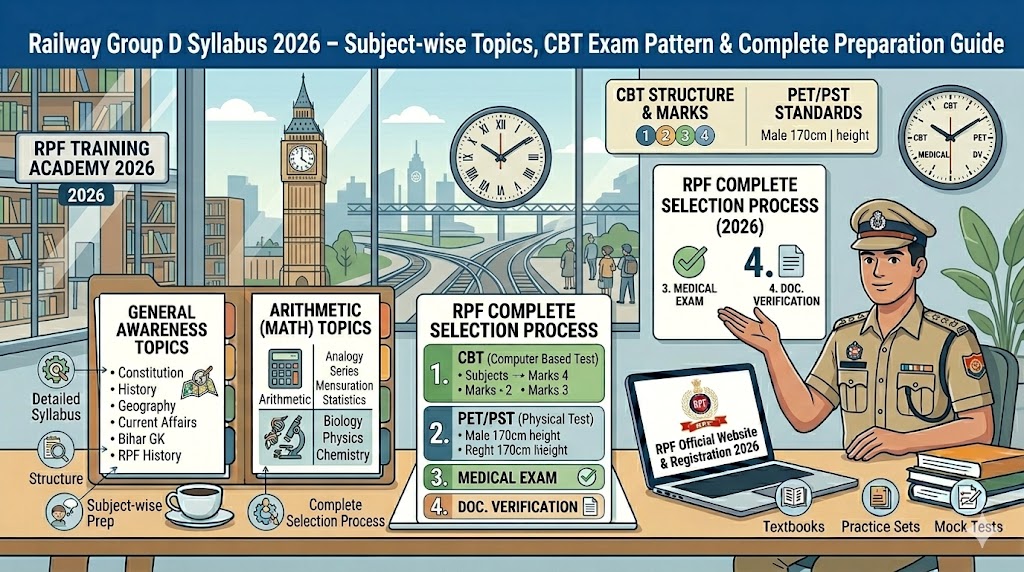
Selection Process — Four Stages
The CBT merit list directly determines who is shortlisted for PET (typically 3 times the number of vacancies, category-wise). PET is qualifying only — it does not add marks. Final selection rank is based entirely on CBT performance, provided PET and Medical are cleared.adda247+1
On CBT 2: Railway Group D standard practice is a single CBT stage. However, the official notification reserves the right to conduct a second CBT stage if necessary to narrow down candidates. For preparation purposes, treat it as a single CBT — but do not dismiss the possibility outright.
CBT Exam Pattern
On negative marking: For every 3 wrong answers, you lose 1 full mark. Unanswered questions carry no penalty — leave a question blank if you have no basis for an educated guess. Blind guessing across all 100 questions would cost approximately 33 marks in deductions. The decision rule: attempt if you can eliminate at least one option; skip if all four options seem equally unfamiliar.
On normalisation: Since CBT is conducted across multiple shifts and dates, raw scores are normalised statistically to correct for variation in difficulty between shifts. A higher raw score from a tougher shift will be normalised upward relative to the same raw score from an easier shift.
CBT Syllabus — Subject by Subject
Mathematics — 25 Questions
Class 6–10 level arithmetic. No advanced mathematics — the emphasis is on speed and accuracy in basic operations.
Priority clusters: Percentage + Profit & Loss + SI/CI + Time & Work + Time-Speed-Distance together account for approximately 40–45% of all Maths questions. Master these five before anything else. NCERT Class 6–10 Maths textbooks cover the complete Group D Maths syllabus — solve every exercise in the Class 8–10 chapters on the priority topics.
General Intelligence and Reasoning — 30 Questions
The largest section in the exam at 30 questions — and the most consistently scorable with structured practice. Railway Group D Reasoning has a notably higher proportion of non-verbal questions (mirror image, figure completion, pattern) compared to SSC exams.
Non-verbal Reasoning (mirror image, figure completion, embedded figures) consistently accounts for 4–6 questions. This sub-section is a reliable scoring opportunity but requires visual practice — it cannot be prepared by reading theory alone.
General Science — 25 Questions
This is the section that distinguishes Railway Group D from SSC exams — Science replaces a second quantitative section. Questions are drawn directly from Class 9 and 10 NCERT Science chapters. Many questions are verbatim or near-verbatim NCERT fact recalls.
Physics — 8–10 Questions
Chemistry — 8–9 Questions
Biology — 7–8 Questions
Science preparation resource: NCERT Class 9 and 10 Science textbooks are the complete source — no supplementary book is needed for Science. Read every chapter including in-text questions; memorise definitions, equations, and diagrams; solve all end-of-chapter exercises. Railway Group D setters draw heavily from NCERT exact phrasing.
General Awareness and Current Affairs — 20 Questions
Current affairs carry the most questions in this section and are the easiest marks to gain with consistent preparation. Follow a monthly current affairs magazine from 8 months before the exam date. For static GK, Lucent’s General Knowledge remains the most widely used and effective single-volume resource at Railway Group D preparation level.
Previous Year Topic Priority — Where Marks Are Consistently Available
Qualifying Marks for CBT
These are the floor qualifying marks — actual competitive cut-offs are significantly higher. In the 2022–23 Group D cycle, General category cut-offs in competitive zones reached 68–75 out of 100. Targeting the qualifying minimum is not a viable preparation strategy.
Physical Efficiency Test (PET) — Stage 2
PET is qualifying only — no marks are added to the merit list. Candidates shortlisted from CBT (3 times vacancies, category-wise) appear for PET. All tasks must be completed in a single sitting.class24+1
PwBD candidates with specific locomotor disabilities are exempt from PET — their selection is subject only to medical suitability for the post.
Critical preparation point: The gap between CBT result and PET date is typically 3–6 weeks — insufficient to build running fitness from zero. Candidates applying for CEN 09/2025 must begin running training now, in parallel with CBT preparation. The 1000m in 4:15 (male) requires sustained preparation — it is a competitive athletic standard for untrained candidates, not a casual jog.
Document Verification — Stage 3
Most common DV rejection cause: OBC-NCL certificate in state format (instead of central government format) or expired OBC-NCL certificate. These take 2–4 weeks to obtain — arrange all documents before the exam, not after results.
Medical Examination — Stage 4
Railway Group D posts (Track Maintainer, Point Man, Helper) generally require Medical Grade B1:
Colour vision deficiency disqualifies candidates for Track Maintainer and Point Man posts — these roles involve reading colour-coded track signals. Candidates with colour blindness may explore other Group D post options (Hospital Attendant, Helper in non-field departments) that carry lower medical grade requirements.
6-Month Preparation Plan
Month 1 — Science Foundation
NCERT Class 9 and 10 Science — read all chapters, both books fully. Do not skip Biology chapters — they are as important as Physics and Chemistry. Note definitions, equations, and diagram labels precisely. Begin 15 Reasoning questions daily (verbal only — analogy, series, coding).
Month 2 — Mathematics Foundation
NCERT Class 6–10 Maths — complete the priority topics first: Percentage, Profit and Loss, SI/CI, Time and Work, Time-Speed-Distance, Mensuration. Solve every exercise. Begin 10 Maths questions daily from each priority topic.
Month 3 — Static GK and Current Affairs
Lucent’s General Knowledge — complete History (Ancient, Medieval, Modern), Geography, Polity, and Economy sections. Begin monthly current affairs magazine; maintain a running notes file of important national events, appointments, sports results, government scheme launches.
Month 4 — Section-wise Practice
25 Science questions daily drawn from NCERT topics — verify every wrong answer against the source chapter. 30 Reasoning questions daily — equal split between verbal and non-verbal. 25 Maths questions daily. Begin current affairs revision from Month 3 notes. Start PET running training now if not already started.
Month 5 — Previous Year Papers
Solve Railway Group D CBT papers from the 2018, 2022, and 2023 cycles in full timed format. Identify topic patterns — which Science subtopics repeat, which Reasoning types appear most, which Maths areas cost time. Correct every wrong answer using NCERT source material, not just solution keys.
Month 6 — Full Mock Tests and Final Revision
Daily full mock tests — 100 questions in 90 minutes, strict timing. Target: finish within 80 minutes to allow 10-minute review. Apply the negative marking decision rule consistently: attempt if you can eliminate at least one option, skip if all four options are unfamiliar. Revise weak sections using chapter summaries and formula sheets. Continue PET running training through this month — taper only in the final week before PET.
Recommended Resources
Common Questions Answered Directly
Is there only one CBT in Railway Group D?
The standard structure is a single CBT. However, the official notification reserves the right to conduct a second CBT stage if deemed necessary to shortlist candidates. Prepare for a single CBT but be aware the option exists.shiksha+1
What is the negative marking?
1/3 mark (0.33) per wrong answer. For every 3 wrong answers, 1 full correct-answer mark is lost. Leave questions blank if you have no basis for an educated elimination.pw+1
Is ITI mandatory?
No. Class 10 + ITI is one valid qualification pathway. Class 10 + National Apprenticeship Certificate (NAC) and Class 12 pass (without ITI) are also accepted for most posts. Verify post-specific requirements from the notification.
What are the minimum qualifying marks?
General/EWS: 40%. OBC: 30%. SC/ST: 25%. Actual competitive cut-offs are 65–75 for General category in high-competition zones.
Which active cycle should I apply for?
CEN 08/2024 (32,438 posts) — CBT already completed; PET upcoming in 2026. CEN 09/2025 (22,195 posts) — applications closed March 2, 2026; exam upcoming. If you applied to CEN 09/2025, focus on CBT. If you took CEN 08/2024 CBT, shift focus to PET preparation now.resultbharat+1
All details subject to change per official RRB/RRC notification. Verify vacancy count, exam dates, and eligibility from your regional RRB website and indianrailways.gov.in before applying.
This website is independent and not affiliated with Indian Railways, RRB, or RRC. Content is for educational and informational purposes only.
Written by Manish | Government exam preparation | sarkariexamresults.net
3 thoughts on “Railway Group D 2026 – CBT Syllabus, Exam Pattern, Physical Test & Complete Selection Guide”