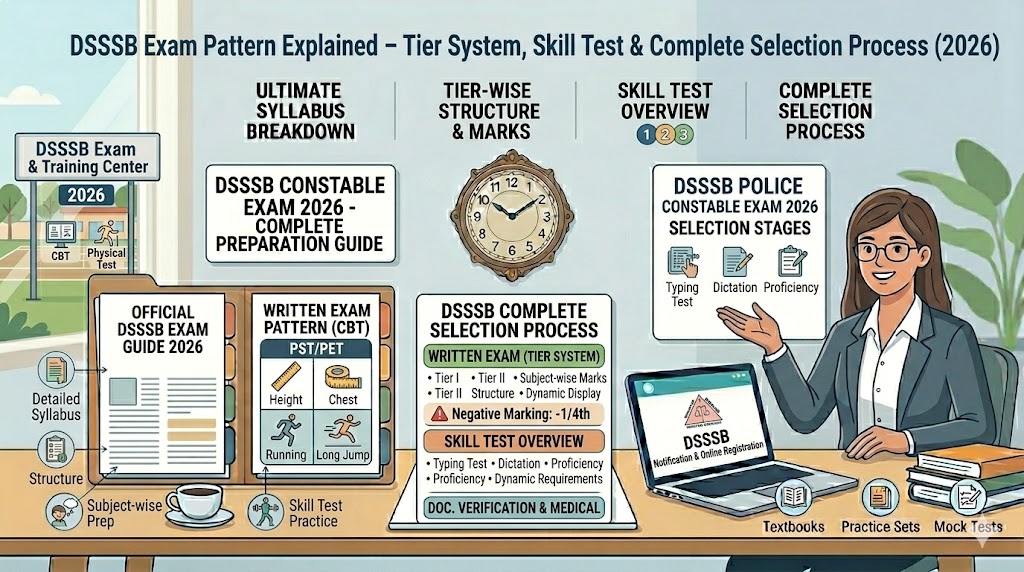
The most important thing to understand about DSSSB before you start preparing is that there is no single DSSSB exam pattern. Every post has its own tier structure, its own subject syllabus, and its own merit calculation formula — all specified in the individual recruitment notification.
A candidate preparing for TGT Maths faces a completely different exam structure than one applying for Junior Secretariat Assistant or Pharmacist, even though both are DSSSB posts.
What is common across all DSSSB posts: CBT mode, 0.25 negative marking, no interview, and the Subject Specific section carrying the highest weightage of any single component.
What Is DSSSB?
The Delhi Subordinate Services Selection Board recruits for Group B and Group C non-gazetted posts across the Government of NCT Delhi — covering:
-
Delhi government departments (Education, Health, Revenue, Finance, PWD, Transport)
-
MCD schools — Primary, Nursery, TGT, and Special Education posts
-
Delhi government hospitals and dispensaries — paramedical, nursing, pharmacy
-
Autonomous bodies — Delhi Jal Board, DSIIDC, DTTDC, and others
Official website: dsssb.delhi.gov.in
DSSSB is not a once-a-year centralised exam like SSC CGL. Vacancies are notified post-wise, in separate advertisements, throughout the year. Each advertisement is post-specific and may carry its own exam date, pattern, and selection process.
The Three Exam Pattern Types
The specific pattern for every post is stated in the official notification. Always verify this before beginning preparation — the structure determines your entire preparation strategy.
One Tier Exam Pattern (200 Marks)
Used for most Group C non-technical and technical posts. This is a single CBT of 200 marks:
The Subject Specific section (100 marks) carries exactly half the total marks — making it the dominant preparation priority for every One Tier post. A candidate who scores 80/100 in Subject Specific while scoring average in other sections will comfortably outscore a candidate who nails all four general sections but scores 50/100 in the subject paper.
Posts following One Tier pattern:
-
Pharmacist, Lab Technician
-
Junior Engineer (Civil, Electrical, Mechanical)
-
Patwari
-
Store Keeper, Statistical Assistant
-
Lower Division Clerk (LDC) — with Typing Skill Test
-
Junior Secretariat Assistant (JSA) — with Typing Skill Test
-
Various MCD posts (PRT, NTT, Special Education Teacher)
Two Tier Exam Pattern
The Two Tier structure applies to higher-level posts requiring deeper subject testing — primarily TGT/PGT teaching posts and senior administrative posts like ASO.
Important: The Two Tier structure is not uniform across all posts. The specific Tier 1 and Tier 2 structures depend on the post. Two major variants are detailed below.
Variant A — Teaching Posts (TGT/PGT)
Tier 1 — Screening Exam:
Duration: 80 minutes | Negative Marking: 0.25 per wrong answer | Purpose: Shortlisting only — Tier 1 marks may or may not be included in final merit depending on the notification.
Tier 2 — Main Exam:
Duration: 120 minutes | Negative Marking: 0.25 per wrong answer | Merit-forming: The entire Tier 2 paper is subject-specific — for TGT Maths, all 200 questions are on Mathematics and its pedagogy.
Variant B — DSSSB ASO (Assistant Section Officer) 2026
The ASO post has a distinct Two Tier structure that includes a descriptive writing component in Tier 2 — not present in the TGT/PGT pattern.adda247+1
ASO Tier 1:
ASO Tier 2:
The final merit for ASO is based on Tier 2 marks. Part B is descriptive — it has no negative marking, but it requires written communication skills that cannot be built from MCQ practice alone. Candidates preparing for ASO must practice essay writing and letter/precis drafting in the final months, not just objective MCQ revision.adda247+1
DSSSB Stenographer 2026 — Distinct CBT Pattern
The Stenographer exam does not follow the standard 20×5 general sections pattern. It has a different section structure:
The Computer Familiarity section (25 marks) is unique to the Stenographer pattern and does not appear in other DSSSB post exams. Candidates applying for Steno must prepare this section separately — it covers internet usage, social media awareness, and MS Office basics (Word, Excel, PowerPoint).
The Stenographer CBT is followed by a Stenography Skill Test for shortlisted candidates.
Active DSSSB 2026 Recruitments
Check dsssb.delhi.gov.in for current and upcoming notifications, admit cards, and result updates.
Subject Specific Syllabus — Common DSSSB Posts
Primary Teacher (PRT) / Nursery Teacher (NTT)
Subject Specific topics (100 marks One Tier / 200 marks Tier 2):
-
Child Development and Pedagogy — developmental stages, Piaget, Vygotsky, Bloom’s Taxonomy, inclusive education, CCE
-
Mathematics Pedagogy — teaching arithmetic and problem-solving at primary level
-
Language Development — first and second language acquisition, teaching reading and writing
-
EVS Pedagogy — experiential learning, concept-based teaching, integration with daily life
-
Curriculum and School Organisation — NEP 2020 provisions, RTE Act 2009, CCE framework
TGT Posts (Tier 2 — 200 Subject Questions)
Junior Engineer (JE)
JE Civil: Structural engineering, building materials, RCC design, surveying, hydraulics, soil mechanics, transportation engineering
JE Electrical: Electrical circuits, DC/AC machines, power systems, control systems, electrical measurements
JE Mechanical: Thermodynamics, fluid mechanics, manufacturing processes, machine design, heat transfer, industrial engineering
Pharmacist
Pharmaceutics, Pharmacology, Pharmaceutical Chemistry (organic, inorganic, analytical), Pharmacognosy, Hospital and Community Pharmacy practice, Pharmacy law and ethics
Lab Technician
Haematology (CBC, blood tests), Clinical Biochemistry (LFT, KFT), Microbiology (culture, staining, infection control), Histopathology, Clinical Pathology, Blood Banking (grouping, cross-matching)
Patwari
Revenue laws of Delhi (Delhi Land Reforms Act, Delhi Land Holdings Act), land records maintenance (Khatauni, Khasra, mutation), survey and settlement operations, computer basics for land record digitisation
General Sections — Syllabus Breakdown
General Awareness (20 Marks)
-
History: Ancient (Maurya, Gupta), Medieval (Delhi Sultanate, Mughal), Modern India (Freedom Struggle — Non-Cooperation, Civil Disobedience, Quit India, key leaders)
-
Geography: Physical features of India, major rivers, climate, agriculture, minerals, transport; basic world geography
-
Polity: Constitution — Preamble, Fundamental Rights (Articles 12–35), Fundamental Duties, DPSP, Parliament, President, judiciary, Panchayati Raj (73rd Amendment), Urban Local Bodies (74th Amendment)
-
Economy: GDP, inflation (WPI/CPI), Five Year Plans, major government schemes (PM-KISAN, MNREGA, Ayushman Bharat, Jal Jeevan Mission, PM Awas Yojana), RBI functions
-
Current Affairs: Last 6–8 months — national events, sports, awards (Bharat Ratna, Padma Awards, Nobel Prizes), summits, policy launches
-
Science and Technology: ISRO missions, defence developments, digital governance (Aadhaar, DigiLocker, UMANG)
-
Delhi-specific GK: Delhi government schemes, Delhi administrative structure, Delhi history and geography — DSSSB frequently tests Delhi-specific content that generic exam guides omit entirely
General Intelligence and Reasoning (20 Marks)
Number series, letter series, alpha-numeric series, analogy (verbal and non-verbal), classification, coding-decoding, blood relations, direction sense, Venn diagrams, syllogism, statement and assumption/conclusion, mirror images, paper folding, figure completion, embedded figures, calendar and clock, ranking and seating arrangement, data sufficiency
Arithmetical and Numerical Ability (20 Marks)
Number System (LCM, HCF, divisibility, surds, indices), simplification and BODMAS, percentage, ratio and proportion, average, profit/loss/discount, simple and compound interest, time and work (pipes and cisterns), time/speed/distance, algebra (linear and quadratic), basic geometry (triangles, quadrilaterals, circles), mensuration (2D and 3D), data interpretation (tables, bar charts, pie charts), basic probability
English Language (20 Marks)
Reading comprehension (1 passage, 4–5 questions), error spotting, sentence improvement, fill in the blanks, synonyms and antonyms, idioms and phrases, one-word substitution, spelling correction, active and passive voice, direct and indirect speech, para jumbles, cloze test
Hindi Language (20 Marks)
गद्यांश पठन बोध, संधि और समास, मुहावरे और लोकोक्तियाँ, पर्यायवाची और विलोम, वाक्य शुद्धि, रिक्त स्थान पूर्ति, वर्तनी शुद्धि, काल/वचन/लिंग, अलंकार (basic), हिन्दी साहित्य सामान्य ज्ञान (for teaching posts)
Skill Tests — Types and Standards
Skill Tests are qualifying — pass or fail only; marks are not added to the merit list.
Typing Skill Test
Used for: LDC, JSA, Tax Assistant, and similar clerical posts.
Typing tests use standard QWERTY keyboard for English and Kruti Dev or Mangal (Unicode) for Hindi. The font and keyboard type are specified in the admit card — practice on the same combination you will use in the actual test.
Stenography Skill Test
Used for: Stenographer Grade C and Grade D posts.
The test involves a passage dictated at the specified speed — candidates take shorthand notes and transcribe on a computer within the time limit. Both speed and accuracy matter.
Computer Proficiency Test (CPT)
Used for: Select technical and administrative posts.
Typical tasks include document creation and formatting in MS Word, spreadsheet creation with formulas in MS Excel, presentation creation in MS PowerPoint, and data entry at a specified speed. CPT requires practical proficiency — not theoretical knowledge of MS Office. Practice on actual software daily.
How Final Merit Is Decided
One Tier posts (without Skill Test):
Final merit = Total marks in One Tier written exam (out of 200)
One Tier posts (with Skill Test):
Final merit = One Tier written exam marks only. Skill Test is qualifying — passing it is required but no marks added.
Two Tier posts (TGT/PGT):
Final merit = Tier 1 marks + Tier 2 marks — exact weightage formula is stated in the specific notification. Some notifications count only Tier 2; others combine both.
ASO (Two Tier with Descriptive):
Final merit = Tier 2 marks only (Part A objective + Part B descriptive combined).
Tiebreaker sequence (if marks are equal):
-
Candidate with fewer wrong answers (less negative marking incurred) ranks higher
-
If still tied — older candidate (by date of birth) ranks higher
6-Month Preparation Strategy
Months 1–2 — Foundation
Confirm your target post and its specific tier pattern from the official notification. Begin Subject Specific syllabus from standard textbooks — NCERT Class 9–12 for teaching posts, diploma/degree textbooks for JE. NCERT Class 6–12 for History, Geography, and Polity (static GK). Start daily current affairs — national + Delhi-specific. For typing/steno posts, begin daily typing practice now, not after results.
Months 3–4 — Section Practice
20 Reasoning questions daily (alternate verbal and non-verbal). 20 Maths questions daily — prioritise Percentage, SI/CI, Time and Work, Mensuration. English: one reading comprehension passage and grammar exercises daily. Hindi: 10 vocabulary questions and one passage daily. Subject Specific: 40–50 questions daily from your post’s topic areas.
Months 5–6 — Mock Tests and Revision
Three full section-wise tests per week. Two full-length timed mock papers per week (80 minutes for Tier 1, 120 minutes for One Tier and Tier 2). For ASO candidates: dedicated weekly essay and letter/precis writing practice — the 100-mark descriptive component requires separate preparation that MCQ practice cannot substitute. Review every wrong answer systematically — identify which topic clusters are costing marks and return to source material, not just more practice questions.
Common Questions Answered Directly
Is there negative marking in DSSSB?
Yes — 0.25 marks deducted per wrong answer in all written exam components (One Tier and both Tiers of Two Tier). The descriptive Part B of ASO Tier 2 has no negative marking.
Does DSSSB have an interview?
No — following Government of India directive, there is no interview for any DSSSB Group B or Group C post. Selection is purely written exam + qualifying Skill Test.
Is domicile restricted to Delhi?
No domicile restriction for most DSSSB posts — any Indian citizen meeting eligibility criteria can apply. Some specific posts carry a preference clause; verify from the individual notification.
Is DSSSB Tier 1 included in final merit for Two Tier posts?
Depends on the specific post. For ASO, final merit is Tier 2 only. For TGT/PGT, check the specific notification — some combine both tiers. Never assume — read the advertisement.
Where are DSSSB notifications published?
dsssb.delhi.gov.in — all notifications, admit cards, answer keys, and results are published here. Set up alerts or check the site directly at regular intervals.
All exam patterns and vacancy details are subject to change per official notification. Always verify from the relevant official DSSSB advertisement at dsssb.delhi.gov.in before preparing.
This website is independent and not affiliated with DSSSB or the Government of NCT Delhi. Content is for educational and informational purposes only.
Written by Manish | Government exam preparation | sarkariexamresults.net
1 thought on “DSSSB Exam Pattern 2026 – Tier System, Skill Test, Selection Process & Post-wise Guide”