The CTET February 2026 result came out on March 30, 2026. Out of 23 lakh candidates who appeared, only 5.97 lakh qualified — a pass rate of just 25.68%. Paper 2 was harsher: only 18.56% cleared it.
That number tells you something important. CTET is not a difficult exam by competitive exam standards — the syllabus is defined, there is no negative marking, and the qualifying mark is 60%. But three-quarters of candidates still fail it, consistently, because they prepare subject content and ignore pedagogy, or memorise theorist names without understanding what the questions are actually asking.
CTET July 2026 notification is expected in April–May 2026 — which means preparation time is now. This guide gives you the complete syllabus for both papers, the exact internal topic breakdown, and a preparation approach that addresses where candidates actually lose marks.
Exam Overview
Paper 1 or Paper 2 — What Are You Applying For?
Candidates who want eligibility for both levels can appear for both papers — same day, different shifts. Separate certificates are issued for each paper cleared.
Paper 1 — Exam Pattern
Paper 2 — Exam Pattern
The subject choice in Paper 2 is made at the application stage and cannot be changed after submission.
The Content vs Pedagogy Split — What Most Candidates Underestimate
Every subject section in CTET is divided into Content questions and Pedagogy questions. Pedagogy is not a minor add-on — it is a significant portion of every section:
Pedagogical questions account for 33–40% of every section. A candidate who only prepares subject content and skips pedagogy is leaving 50–60 marks unaddressed across a 150-mark paper. This is the most common reason otherwise well-prepared candidates score in the 70s and 80s instead of the 90s.
Section 1 — Child Development and Pedagogy (30 Marks, Both Papers)
CDP is compulsory in both papers — same topic framework, same marks. Paper 2 tests the same concepts at a deeper application level.
Sub-part Breakdown
Child Development — 15 Questions
-
Growth vs development — meaning, principles, stages across infancy, childhood, adolescence
-
Physical, cognitive, social, emotional, and language development
-
Jean Piaget — four stages (Sensorimotor, Pre-operational, Concrete Operational, Formal Operational), schema, assimilation, accommodation, equilibration, conservation, egocentrism
-
Vygotsky — Zone of Proximal Development, scaffolding, More Knowledgeable Other
-
Erikson — eight psychosocial stages, crisis at each stage
-
Kohlberg — three levels, six stages of moral development
-
Heredity and environment — their respective roles in development
-
Gender as a social construct — gender stereotypes in education
-
Socialisation — family, peer group, school, media
-
Child-centred and progressive education — John Dewey
-
Multiple intelligences — Howard Gardner’s eight intelligences
-
Critical perspective on IQ and intelligence testing
Inclusive Education — 5 Questions
-
Meaning and importance of inclusive education
-
RTE Act 2009 — key provisions
-
Learning disabilities — Dyslexia, Dyscalculia, Dysgraphia, ADHD, Autism (characteristics and classroom identification)
-
Gifted and talented children — enrichment strategies
-
Slow learners — identification and support
-
Socially disadvantaged children — SC/ST/minority/girls
-
Differentiated instruction, peer tutoring, modified assessment
Learning and Pedagogy — 10 Questions
-
How children think and learn — active knowledge construction
-
Intrinsic vs extrinsic motivation — Maslow’s Hierarchy of Needs
-
Learning theories — Thorndike (trial and error), Pavlov (classical conditioning), Skinner (operant conditioning), Kohler (insight learning)
-
Factors affecting learning
-
Why children fail — cognitive, emotional, social, motivational causes
-
Teaching strategies for different learners
-
Assessment — formative, summative, diagnostic; CCE framework
Section 2 — Language I (30 Marks, Both Papers)
Language I is the candidate’s chosen medium of classroom instruction — tested at higher proficiency than Language II.
Comprehension (15 questions): Two unseen passages — one prose (literary, narrative, scientific, or discursive) and one poem. Questions test comprehension, inference, grammar in context, literary appreciation, and verbal ability.
Language Pedagogy (15 questions): Language acquisition theories — first and second language acquisition. Role of language in cognition. Multilingual and multilevel classroom challenges. LSRW skills (Listening, Speaking, Reading, Writing) development. Communicative approach to language teaching. Remedial teaching for language difficulties. Formative and summative evaluation of language proficiency.
Available language options: Hindi, English, Assamese, Bengali, Gujarati, Kannada, Malayalam, Marathi, Odia, Punjabi, Sanskrit, Tamil, Telugu, Urdu, and other scheduled languages. Language I and Language II must be different from each other.
Section 3 — Language II (30 Marks, Both Papers)
Language II tests general communication ability at slightly lower proficiency depth than Language I.
Comprehension (15 questions): Two unseen prose passages. No poetry passage (unlike Language I). Questions test comprehension, grammar accuracy, and verbal ability.
Pedagogy (15 questions): Same framework as Language I pedagogy — acquisition theories, multilingual classrooms, LSRW skills, communicative teaching, evaluation approaches.
Section 4 (Paper 1) — Mathematics (30 Marks)
Class 1–5 level content with a 20:10 content-to-pedagogy split.
Content — 20 Questions:
-
Number System — natural and whole numbers, place value, addition, subtraction, multiplication, division, LCM and HCF, fractions, decimals
-
Geometry — 2D and 3D shapes, symmetry, line of symmetry, mirror image
-
Measurement — length, weight, capacity, time, money
-
Patterns and basic algebra introduction (Class 4–5 preparatory level)
-
Data Handling — tables, bar graphs, pictographs — reading and interpretation
Pedagogical Issues — 10 Questions:
-
Nature of Mathematics — logical thinking, abstraction, structure
-
How children understand mathematical concepts
-
Place of Mathematics in the curriculum
-
Language of Mathematics and common learning errors
-
Teaching strategies — problem-solving, activity-based, games and puzzles
-
Maths anxiety — causes, identification, remediation
-
Diagnostic and remedial teaching
-
Formative assessment in Mathematics
Section 5 (Paper 1) — Environmental Studies / EVS (30 Marks)
EVS appears only in Paper 1. Content is drawn from NCERT Class 3–5 “Looking Around” textbooks — six thematic areas with a 20:10 content-to-pedagogy split.
Content — 20 Questions:
Family and Friends: Family structure (joint and nuclear), community occupations, pets and wild animals, plants and their uses
Food: Sources of food, regional food variety across India, food preservation methods, basic nutrition
Shelter: Types of houses across India and their climate adaptation, animals and their shelters
Water: Sources, traditional water harvesting methods, water conservation, water cycle, water pollution
Travel: Means of transport, basic map reading, migration of people and animals
Things We Make and Do: Indian crafts and occupations (weaving, pottery, metalwork), simple machines, traditional knowledge
Pedagogical Issues — 10 Questions:
-
Integrated nature of EVS (Science + Social Studies at primary level)
-
Significance in primary education
-
Experiential learning, storytelling, hands-on experiments
-
Discussion and problem-solving in EVS
-
CCE in EVS — activity-based continuous assessment
-
Making EVS relevant to children’s real-life experiences
-
Environmental concerns — ecology, biodiversity, sustainability at primary level
Section 4 (Paper 2, Option A) — Mathematics and Science (60 Marks)
For candidates targeting Maths/Science teaching at Classes 6–8. Content at Class 6–8 level, questions potentially going up to senior secondary depth.
Mathematics — 30 Questions (20 Content + 10 Pedagogy)
Content:
-
Number System — rational numbers, exponents, squares and square roots, cubes and cube roots
-
Algebra — algebraic expressions, identities, linear equations in one variable, introduction to graphs
-
Ratio and Proportion — percentage, profit and loss, simple and compound interest
-
Geometry — lines and angles, triangles (properties, congruence, similarity), quadrilaterals, basic circles
-
Mensuration — area and perimeter of plane figures; surface area and volume of cube, cuboid, cylinder
-
Data Handling — frequency tables, bar charts, pie charts, histograms, mean, median, mode, basic probability
Pedagogy: Nature of mathematical thinking, problem-solving, community mathematics, constructivist approach, error analysis, diagnostic teaching, assessment strategies.
Science — 30 Questions (20 Content + 10 Pedagogy)
Content (NCERT Class 6–8 Science):
-
Food — sources, components (carbohydrates, proteins, fats, vitamins, minerals), preservation, microorganisms
-
Materials — properties, separation methods, synthetic fibres, metals and non-metals, coal and petroleum, combustion
-
Living World — cell structure, plant and animal nutrition, respiration, transportation, reproduction, microorganisms
-
Motion and Forces — force, friction, pressure, sound, light (reflection, refraction), electricity, magnets
-
Natural Phenomena — weather, seasons, water cycle, earthquakes (basic), pollution
-
Natural Resources — water, air, soil, forests, minerals, conservation
Pedagogy: Aims of Science education, inquiry-based and activity-based approaches, observation and experimentation, beyond the textbook, remedial teaching in Science, assessment of scientific learning.
Section 4 (Paper 2, Option B) — Social Studies / Social Sciences (60 Marks)
For candidates targeting Social Studies teaching at Classes 6–8. Content drawn from NCERT Class 6–8 History, Geography, and Civics — with a 40:20 content-to-pedagogy split.
Content — 40 Questions
History (NCERT Class 6–8 Our Pasts I, II, III):
-
Sources of history, timeline, archaeological evidence
-
Early civilisations — Harappan, Vedic period
-
Kingdoms — Mahajanapadas, Maurya, Gupta, Chola, Delhi Sultanate
-
Mughal Empire — Akbar, Aurangzeb, administration, architecture, culture
-
Colonial period — British expansion, economic impact, social changes
-
Tribal societies, pastoralists, farmers in historical context
-
Nationalist movement — 1857 to 1947
-
India after independence — partition, Constitution, state integration
Geography (NCERT Class 6–8 The Earth: Our Habitat, Our Environment, Resources and Development):
-
Solar System, globe, latitudes and longitudes
-
Earth’s motions — rotation, revolution, seasons
-
Map types, map reading, scale
-
Major domains — lithosphere, hydrosphere, atmosphere, biosphere
-
India — physical features, climate, natural vegetation, wildlife
-
Human environment — settlements, transport, communication
-
Resources — types, conservation, agriculture (food and commercial crops)
Political Science (NCERT Class 6–8 Social and Political Life I, II, III):
-
Diversity in India — prejudice, discrimination, equality
-
Government levels — local, state, national; types of government
-
Parliament — elections, how laws are made
-
Judiciary — courts, FIR, public interest litigation
-
Secularism — meaning and Indian context
-
Markets, traders, economic roles of government
-
Gender and social change, social justice, equality and inequality
Pedagogical Issues — 20 Questions
-
Nature of Social Studies and Social Sciences
-
Primary and secondary sources of information
-
Projects and field visits
-
Critical thinking and classroom discourse
-
CCE tools for Social Studies
-
Making Social Studies meaningful and relevant
Qualifying Marks
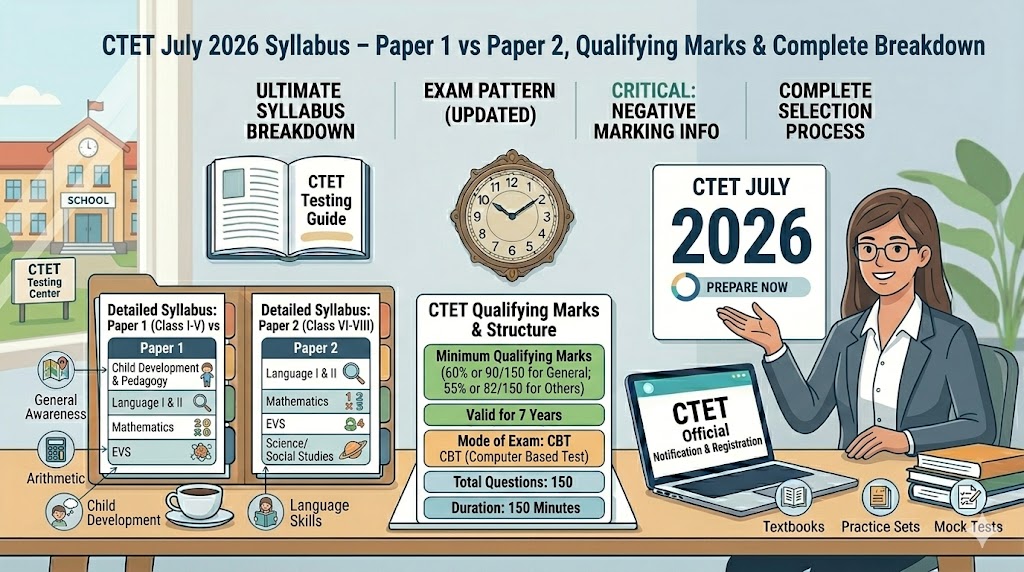
To put this in context: in the February 2026 exam, only 33.69% of Paper 1 candidates and 18.56% of Paper 2 candidates cleared this threshold. The qualifying mark is not the hard part — preparation quality is.
The CTET certificate carries lifetime validity — a certificate earned in July 2026 remains valid permanently with no renewal required.
4-Month Preparation Plan
Month 1 — CDP and Language Foundation
CDP is compulsory in both papers and directly applicable to language pedagogy as well — begin here. Complete all three CDP sub-parts: Child Development, Inclusive Education, Learning and Pedagogy. Understand each theory conceptually, not just the theorist’s name — CTET questions test application, not recall. Begin Language I and II reading comprehension: one passage daily with timed practice.
Month 2 — Subject Content
Paper 1 candidates: NCERT Class 3–5 Mathematics chapters + “Looking Around” EVS books (all three volumes). Paper 2 Maths/Science: NCERT Class 6–8 Science and Maths (all chapters). Paper 2 Social Studies: All six NCERT books — Our Pasts I/II/III, Earth Our Habitat, Our Environment, Resources and Development, Social and Political Life I/II/III. Read these as primary sources, not summaries.
Month 3 — Pedagogy and Section-wise Practice
This is the month most candidates skip and most candidates regret. Study pedagogical issues section by section — not as definitions to memorise but as teaching methodology to understand. EVS pedagogy, Maths pedagogy, Science pedagogy, Social Studies pedagogy, and Language pedagogy all require separate preparation. Solve 30-question section-wise mock tests daily. Focus specifically on NEP 2020 provisions, RTE Act 2009 key clauses, and CCE framework — these appear across CDP and subject pedagogy both.
Month 4 — Full Papers and Final Revision
Two complete 150-question timed mock papers per week — strict 150-minute limit. Since there is no negative marking, all 150 questions must be attempted every time — build this discipline in practice. Track which sections and which topic types are costing marks. Final two weeks: theory summaries only — Piaget stages, Vygotsky ZPD diagram, Kohlberg levels, Thorndike’s laws, Skinner reinforcement types, Gardner’s intelligences.
Recommended Resources
Common Questions Answered Directly
When is the CTET July 2026 exam?
Notification expected April–May 2026 on ctet.nic.in. Exam expected July 2026. No official date confirmed as of now — check ctet.nic.in for updates.adda247+1
Is there negative marking?
No. Wrong answers score zero — no deduction. Attempt all 150 questions without exception.pw+1
Can I appear for both papers?
Yes — same day, different shifts. Separate certificates issued for each paper you qualify.
How long is the certificate valid?
Lifetime — permanent validity. The earlier 7-year limit was removed in 2021.
What percentage of candidates qualified in February 2026?
25.68% overall — 33.69% in Paper 1, 18.56% in Paper 2. The primary reason for failure is inadequate pedagogy preparation, not weak subject knowledge.
Does CTET guarantee a teaching job?
No. CTET is eligibility certification — it qualifies you to apply for teaching posts in KVS, NVS, central government-aided schools, and many state-level recruitments. Actual appointment requires a separate state or central teacher recruitment process.
Official notification, admit card, and result updates at ctet.nic.in. Information in this article is based on CTET examination patterns from previous cycles and is subject to change per official notification.
This website is not affiliated with CBSE or any government body. Content is for educational and informational purposes only.
Written by Manish | Teacher eligibility exam preparation | sarkariexamresults.net
3 thoughts on “CTET July 2026 – Complete Syllabus, Paper 1 vs Paper 2 Breakdown & Preparation Guide”