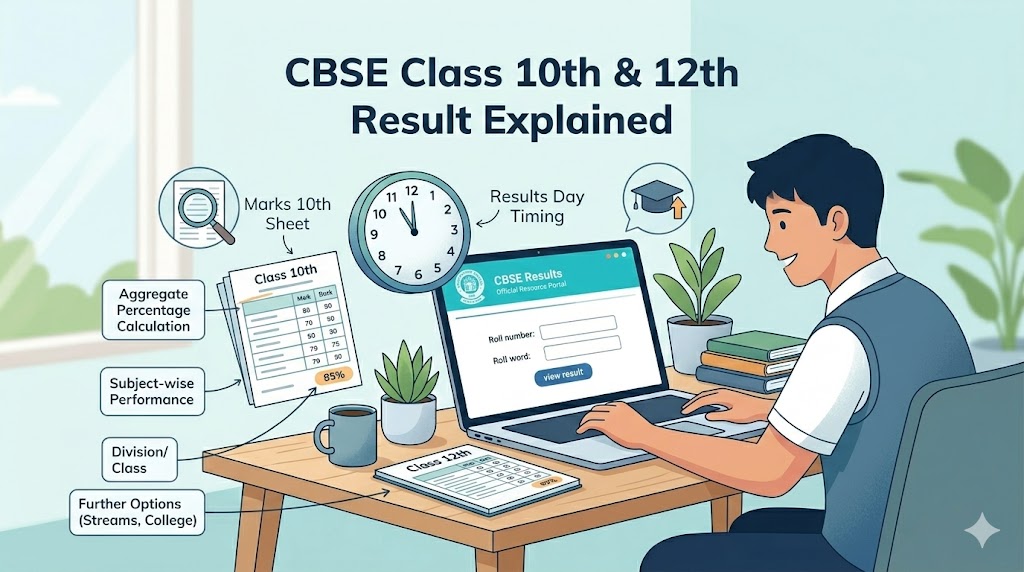
Every year, when CBSE results come out, the same question floods every school WhatsApp group: “Mere bache ko A2 grade aaya — toh percentage kya hua?” Parents compare with state board students, students feel confused about their own marksheets, and everyone wonders what these grades actually mean in real life.
If you are a Class 10 or Class 12 student — or a parent trying to decode the CBSE result system — this guide explains everything clearly. How grades are assigned, what the passing rules actually are, how to calculate your percentage, and what your result means for college admissions. No confusion, just honest answers.
Expert Insight
As a teacher with 10+ years of experience working with CBSE students, I have seen firsthand that the biggest confusion after result day is not about marks — it is about what those marks actually mean.
Students mix up Class 10 and Class 12 passing rules. Parents assume a low theory score means automatic failure. And nearly everyone calculates percentage wrong because they are still using outdated methods. This guide is written specifically to clear all of that — not just explain the system, but make sure you walk away knowing exactly where you stand and what to do next.
CBSE Result 2026 – Important Dates
Bookmark these dates — especially the post-result verification window, which closes within 15–20 days and is missed by thousands of students every year.
How CBSE Grades Work – The 9-Point Scale
CBSE uses a 9-point grading scale for both Class 10 and Class 12. For each subject, your marks fall into a grade band, and a grade along with a grade point is assigned.
What appears on your marksheet: Both your actual marks (theory marks, internal assessment marks, and total) AND the positional grade are printed side by side on the marksheet — for both Class 10 and Class 12.
Note: Marksheet format may slightly vary depending on CBSE updates in a given year. Always refer to the official marksheet issued by cbse.gov.in as the final authority.
Why A1 and A2 are the same in practice: A student scoring 91 and a student scoring 99 both receive A1 with grade point 10. CBSE deliberately designed it this way — the goal is to reduce extreme pressure over individual marks.
What Is Shown on the CBSE Marksheet?
Since your actual marks are printed on the marksheet, you can calculate your own percentage directly — no formula or conversion needed.
How to calculate your percentage from marks:
Percentage = (Total Marks Obtained in Best 5 Subjects ÷ 500) × 100
For example, if your total marks across five subjects are 412 out of 500:
412 ÷ 500 × 100 = 82.4%
This is your real, actual percentage — which is what colleges, competitive exams, and scholarship bodies will use.
Class 10 Assessment Structure
For subjects without practicals (Languages, Maths, Social Science):
Internal Assessment (20 marks) includes:
-
Periodic Tests — 10 marks
-
Subject Enrichment Activities — 5 marks
-
Portfolio / Notebook — 5 marks
For subjects with practicals (Science, IT, etc.):
In my experience, students who stay consistent with internal assessment throughout the year often push their grade from B1 to A2 without needing extraordinary board exam performance. Those 20 marks are fully in your control — do not waste them.
Class 12 Assessment Structure
Class 12 practicals are evaluated externally — by CBSE-appointed examiners, not your school teachers. Internal assessment marks are submitted by schools to CBSE’s portal before board exams begin.
Passing Rules for Class 10 – The Actual Rule
This is the most commonly misunderstood rule in CBSE. I have seen students panic unnecessarily because they assumed Class 10 works like Class 12. It does not.
The 33% rule for Class 10 is based on the combined total — not on theory alone.
A student passes Class 10 if:
-
Combined total of Theory + Internal Assessment = 33 marks or more out of 100 per subject
-
Grade above E in internal assessment subjects
Practical example:
A student scores 20 out of 80 in the theory paper but gets 17 out of 20 in internal assessment. Their combined total = 37 out of 100 — which is above 33. They pass that subject.
This is a confirmed CBSE rule and specifically applies to Class 10 only.
Grace marks: CBSE may apply up to 5 grace marks per subject in maximum 2 subjects — at its own discretion. This is a safety net, not a strategy to depend on.
Sixth subject provision: If a student fails one subject but opted for a 6th additional subject, the 6th subject may replace the failed one — subject to CBSE’s Scheme of Studies rules.
Passing Rules for Class 12 – Stricter Than Class 10
Class 12 has a different and stricter rule. Here, each component is evaluated independently.
A student passes Class 12 if:
-
Minimum 33% in the Theory (External) exam separately
-
80-mark paper → minimum 26 marks
-
70-mark paper → minimum 23 marks
-
-
Minimum 33% in the Practical exam separately
-
Grade above E in all internal assessment subjects
-
Combined total per subject is 33% or above
The key difference: In Class 12 you cannot cover a low theory score with high practical marks. A student scoring 20 out of 70 in the Physics theory exam has not passed — even with a perfect practical score. This catches many students off guard, especially in Science stream.
How to Calculate Your Percentage from CBSE Marks
Step 1: Identify your total marks in your best 5 main subjects from the marksheet.
Step 2: Apply this formula:
Percentage = (Sum of Best 5 Subject Marks ÷ 500) × 100
Example:
Percentage = 424 ÷ 500 × 100 = 84.8%
Use this percentage for all college admissions, competitive exam eligibility, and scholarship applications.
5-Point Scale for Co-Scholastic Subjects
This 5-point scale applies to Art Education, Physical Education, and Work Education. These grades do not affect your percentage calculation but appear separately on your marksheet.
What Happens If You Fail?
Class 10:
-
Fail in 1 or 2 subjects → Compartment exam in July
-
Fail in 3 or more subjects → Repeat the full year
Class 12:
-
Fail in 1 subject → Compartment exam in July
-
Fail in 2 or more subjects → Repeat the full year
Clearing compartment earns a pass certificate — but the marksheet notes that the pass was through compartment. Some government job applications and entrance exam eligibilities specifically ask about this. Always check the rules of the specific body before assuming it is treated identically to a regular pass.
Marks Verification – What to Do If Something Looks Wrong
CBSE provides three formal options after results:
1. Verification of Marks — Checks that marks were correctly totalled and transferred. Fee per subject. No re-evaluation of answers.
2. Photocopy of Answer Sheet — You receive a scanned copy of your evaluated board exam answer paper.
3. Re-evaluation — After receiving the photocopy, you can apply for specific questions to be re-evaluated. Marks can go up or down.
Critical warning: All applications must be submitted within 15–20 days of result declaration. This window is strict — missing it means losing your chance permanently.
How Your CBSE Result Affects College Admissions
Delhi University (DU)
DU uses CUET scores for undergraduate admissions since 2022. Class 12 marks are used only for eligibility verification — most courses require 45–50% minimum. Merit is purely CUET-based.
Central Universities
Actual Class 12 percentage from marksheet marks is used for eligibility. CUET score determines final rank.
IITs, NITs, IIITs (JEE)
JEE eligibility requires either 75% marks in Class 12 OR placement in the top 20 percentile of your board’s passing candidates — whichever is lower. Actual marks-based percentage applies.
NEET (Medical Admissions)
Minimum 50% marks in Physics, Chemistry, and Biology combined — calculated from actual marks, not any formula.
What Is New in CBSE 2026 Exams
-
Competency-Based Questions now form ~50% of papers — case studies, source-based, and real-world application problems that test genuine understanding.
-
Rationalised syllabus continues — the streamlined syllabus from 2020 onward remains in effect.
-
Internal assessment submitted before exams — schools upload marks to CBSE portal before board exams begin.
-
Holistic Report Card — CBSE encourages schools to record co-curricular achievements and life skills alongside academic marks.
What You Should Do After Your CBSE Result
Getting your result is just the first step. Here is exactly what to do next:
✔ Calculate your exact percentage using the Best of 5 formula from your marksheet marks — do not estimate or guess.
✔ Check college and entrance exam eligibility — compare your percentage against the specific cutoffs of courses you are targeting.
✔ Verify your result on the official website — always confirm from cbseresults.nic.in, not from third-party apps or unofficial sites.
✔ Download and save your digital marksheet — keep multiple backup copies in email, Google Drive, and as a physical printout.
✔ If anything looks wrong, apply for verification immediately — the window is only 15–20 days and closes fast.
✔ If you are in compartment, do not delay registration — compartment exam forms have a short application period right after results.
These steps take less than an hour — but skipping them has caused real problems for students during admissions season.
Frequently Asked Questions
Q. Does the CBSE Class 10 marksheet show actual marks or only grades?
Both. Actual theory marks, internal assessment marks, and total per subject are all printed alongside the grade. You can calculate your percentage directly from these numbers.
Q. What is the minimum marks needed to pass Class 10?
A combined total of 33 marks out of 100 per subject — theory and internal assessment combined. There is no separate minimum for theory alone in Class 10.
Q. Is the Class 12 passing rule the same as Class 10?
No. Class 12 is stricter — you must score at least 33% in theory separately AND 33% in practical separately. Combined scoring is not sufficient for Class 12.
Q. How do I calculate my percentage?
Add total marks in best 5 subjects, divide by 500, multiply by 100. Example: 424 ÷ 500 × 100 = 84.8%.
Q. What happens if I fail two subjects in Class 12?
You must repeat the year. Compartment is only available for single-subject failures in Class 12.
Q. Does CBSE give grace marks?
CBSE may apply up to 5 grace marks per subject in maximum 2 subjects — at its discretion. This is not guaranteed.
Q. Is my CBSE percentage accepted for JEE and NEET eligibility?
Yes — using actual marks-based percentage calculated from your Class 12 marksheet.
Written by Manish
10+ years of teaching experience | Helping students understand exams, results, forms, and government job preparation
sarkariexamresults.net
For official result updates, verification applications, and exam notifications, always refer directly to cbse.gov.in and cbseresults.nic.in.