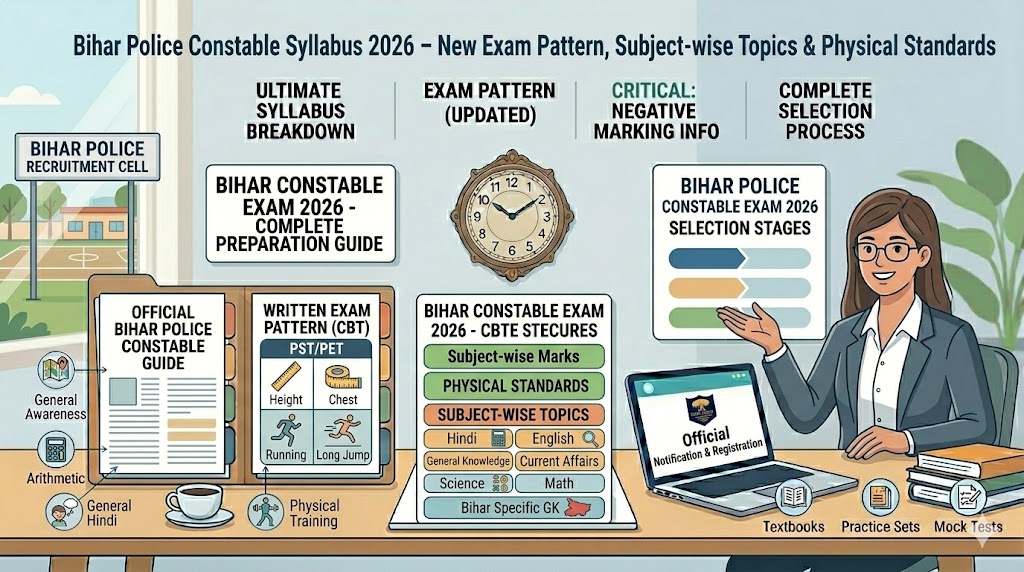
Here is the reality of Bihar Police Constable that most guides present backwards: the written exam is the easier gate, and the physical test is where selection actually happens. The written exam only requires 30% to qualify — but in the 2025 cycle, actual cut-offs for General male candidates went as high as 68 out of 100 because 5 times the vacancies were called for PET. The candidates who scored 68 and failed the physical test got nothing. The ones who scored 40 and excelled at PET got selected.
Understanding that structure changes how you prepare. Both the written exam and physical training must run in parallel from day one.
Recruitment Overview
Note: A new 2026 recruitment notification may be released by CSBC with updated vacancies. Always verify current vacancy numbers at csbc.bihar.gov.in before applying.
Selection — Three Stages, One That Decides Your Rank
The final merit list is based entirely on PET performance — not written exam marks. The written exam is a gate. PET is the competition.askfilo+1
What this means in practice: a candidate who scores 70 in the written exam and performs poorly in PET will rank below a candidate who scored 35 in the written exam and topped the PET scoring. The written exam decides who gets through the gate; PET decides who gets the job.
Written Exam Pattern
On no negative marking: Since there is zero penalty for wrong answers, every single question must be attempted — even if you have to guess. Leaving a question blank when there is no negative marking is giving away a free mark. This is a preparation and exam strategy point that directly affects your score.
On the 30% qualifying mark vs actual cut-off: The 30% minimum is a floor, not a target. In the 2025 cycle, CSBC shortlisted approximately 5 times the vacancy count for PET — meaning the actual written cut-off for General male candidates was 68 out of 100. Scoring 30% qualifies you in theory; you need 60–70% to realistically remain in PET contention.
Written Exam — Subject Breakdown
All subjects are tested at Class 10 (Matric) level — NCERT Class 9 and 10 textbooks cover the vast majority of the written exam syllabus.careerpower+1
Subject 1 — General Knowledge and Current Affairs (25 Questions)
Bihar-specific content is a consistent and distinctive feature of this exam — questions on Bihar history, geography, rivers, crops, and government schemes appear regularly and do not appear in SSC or central government exams. Prepare Bihar GK as a separate dedicated topic.
History
Modern India and Freedom Struggle:
-
Revolt of 1857 — causes, key centres, leaders, outcome
-
Formation of Indian National Congress, early phases
-
Non-Cooperation (1920), Civil Disobedience (1930), Quit India (1942)
-
Mahatma Gandhi, Bhagat Singh, Subhas Chandra Bose
Bihar-specific History (high priority):
-
Champaran Satyagraha (1917) — Gandhi’s first satyagraha in India, happened in Bihar
-
Bihar’s role in the 1857 revolt
-
Jayaprakash Narayan — JP Movement
-
Important historical sites — Nalanda, Bodh Gaya, Rajgir, Vaishali, Pataliputra
Ancient and Medieval (basics):
-
Maurya Empire — Chandragupta, Ashoka, Dhamma, Edicts
-
Gupta Empire — Golden Age
-
Delhi Sultanate and Mughal Empire — major rulers, key contributions
Geography
India Geography:
-
Physical features — Himalayas, Indo-Gangetic Plains, Deccan Plateau
-
Major rivers — Ganga, Yamuna, Brahmaputra, Godavari, Krishna, Kaveri
-
Climate — monsoon mechanism, seasons
-
Agriculture — Kharif, Rabi, Zaid crops; major producing states
-
Soil types — alluvial, black, red, laterite
-
Minerals — coal (Jharkhand), iron ore (Odisha), petroleum (Assam)
Bihar Geography (high priority):
-
Rivers of Bihar — Ganga, Son, Gandak, Koshi, Bagmati, Falgu — tributaries and flood patterns
-
Districts and administrative divisions
-
Key crops — paddy, wheat, maize, lychee (Bihar is India’s largest lychee producer)
-
Industries and minerals in Bihar
-
Major cities — Patna, Gaya, Muzaffarpur, Bhagalpur, Darbhanga
Indian Polity
-
Preamble — sovereign, socialist, secular, democratic, republic
-
Fundamental Rights (Articles 12–35) — key rights and exceptions
-
Fundamental Duties (Article 51A)
-
DPSP — major directives
-
Parliament — Lok Sabha, Rajya Sabha composition and functions
-
President, Prime Minister — election, roles, constitutional position
-
State government — Governor, Chief Minister, Vidhan Sabha
-
Judiciary — Supreme Court, High Courts, jurisdiction
-
Panchayati Raj — 73rd Amendment, three-tier structure
-
Election Commission — role, EVM, Model Code of Conduct
Economics
-
Basic terms — GDP, GNP, NNP, per capita income
-
Inflation — WPI, CPI, control measures
-
Budget basics — fiscal deficit, revenue vs capital expenditure
-
Bihar economy — agricultural structure, major industries
-
Government schemes — PM-KISAN, MNREGA, Ayushman Bharat, Jal Jeevan Mission, PM Awas Yojana
Current Affairs
-
National government decisions and major policy launches
-
International summits and bilateral agreements
-
Awards — Bharat Ratna, Padma Awards, Nobel Prize (6–8 months before exam)
-
Sports — national and international championships
-
Bihar-specific developments — new schemes, projects, infrastructure
-
Science and Technology — ISRO missions, defence developments
Subject 2 — Physics (25 Questions)
Class 9–10 NCERT Physics covers approximately 85% of this section. Key topics:
Mechanics:
-
Physical measurements — SI units, fundamental and derived units
-
Motion — displacement, velocity, acceleration; equations of motion; velocity-time graphs
-
Newton’s three laws — inertia, momentum, action-reaction, conservation of momentum
-
Work, energy, power — kinetic and potential energy, conservation of energy
-
Gravitation — universal law, acceleration due to gravity, escape velocity basics
-
Pressure — Archimedes’ principle, Pascal’s law, atmospheric pressure
Heat and Thermodynamics:
-
Heat vs temperature — thermometer scales, conversion between Celsius/Kelvin/Fahrenheit
-
Thermal expansion — linear, area, volumetric
-
Specific heat and latent heat
-
Heat transfer — conduction, convection, radiation
Sound and Waves:
-
Sound propagation, speed in different media
-
Reflection of sound, echo, resonance
-
Electromagnetic spectrum — types and applications
Electricity and Magnetism:
-
Electric charge, current, potential difference; Ohm’s Law
-
Resistance — series and parallel circuits; electric power; Joule’s heating law
-
Magnetic effects of current — electromagnets, electric motor
-
Electromagnetic induction — basic concept; AC and DC
-
Earth’s magnetic field, properties of magnets
Optics:
-
Reflection — laws, plane and spherical mirrors, image formation
-
Refraction — laws, glass slab, prism
-
Lenses — convex and concave; image formation; power of lens
-
Human eye — structure, defects (myopia, hypermetropia), correction
-
Dispersion — spectrum, rainbow
Modern Physics (basics):
-
Atomic structure — atomic number, mass number, isotopes
-
Radioactivity — basic concept
-
Photoelectric effect — concept only
Subject 3 — Chemistry (25 Questions)
Class 9–10 NCERT Chemistry is the primary source. Key topics:
Matter and Its Properties:
-
States of matter and changes of state — melting, boiling, sublimation
-
Elements, compounds, and mixtures — differences with examples
-
Separation techniques — filtration, distillation, chromatography
Atomic Structure:
-
Atomic models — Dalton, Thomson, Rutherford, Bohr
-
Electron, proton, neutron; atomic number and mass number
-
Electronic configuration of first 20 elements
-
Isotopes and isobars
Periodic Table:
-
Development of periodic table; Modern Periodic Law
-
Groups and periods; key trends in atomic radius, ionisation energy
-
Metals, non-metals, metalloids classification
Chemical Reactions:
-
Types — combination, decomposition, displacement, redox
-
Balancing equations
-
Oxidation and reduction identification
-
Endothermic and exothermic reactions
Acids, Bases and Salts:
-
Properties of acids and bases; pH scale (0–14)
-
Neutralisation reaction
-
Important salts — NaCl, NaHCO₃ (baking soda), Na₂CO₃ (washing soda), CaSO₄·½H₂O (plaster of paris)
Metals and Non-metals:
-
Physical and chemical properties
-
Reactivity series of metals
-
Corrosion — rusting, prevention methods
-
Alloys — brass, bronze, steel, stainless steel (composition and use)
Carbon and Its Compounds:
-
Organic basics — hydrocarbons (alkanes, alkenes, alkynes)
-
Functional groups — alcohol, aldehyde, carboxylic acid
-
Ethanol, ethanoic acid, soaps and detergents
-
Polymers — natural and synthetic
Environmental Chemistry:
-
Air, water, soil pollution — causes, pollutants, effects
-
Greenhouse effect and global warming
-
Ozone depletion — causes and effects
-
Acid rain
-
Biodegradable vs non-biodegradable substances
Fuels:
-
Solid (coal), liquid (petroleum), gaseous (LPG, CNG) fuels
-
Calorific value; ideal fuel characteristics
-
Fractional distillation of petroleum — products and uses
Subject 4 — Mathematics (25 Questions)
Class 6–10 level arithmetic and basic geometry:
Percentage + Profit and Loss + SI/CI + Time and Work + Mensuration account for approximately 45–50% of Maths questions. Master these five clusters before anything else.
Physical Standard Test (PST)
PST is measured before PET begins — candidates who do not meet height and chest standards are eliminated before PET events start:pw+2
Physical Efficiency Test (PET) — The Merit-Forming Stage
PET is where your selection rank is built. The events are scored — each event carries marks, and those marks form your PET score which decides your final rank. It is not simply pass/fail thresholds.
PET Events and Marks (Male):
Scoring breakdown within each event (Male):
Shot Put (16 lb):
-
16–17 feet → 9 marks | 17–18 feet → 13 marks | 18–19 feet → 17 marks | 19–20 feet → 21 marks | 20+ feet → 25 marks | Under 16 feet → Disqualified
High Jump:
-
4 feet → 13 marks | 4 feet 4 inches → 17 marks | 4 feet 8 inches → 21 marks | 5 feet or more → 25 marks | Under 4 feet → Disqualified
PET Events (Female):
Understanding that PET is scored — not just pass/fail — fundamentally changes your preparation approach. You cannot simply clear the minimums and expect selection. You need to exceed the minimum thresholds on every event to accumulate competitive marks. The candidate who throws 20+ feet in shot put (25 marks) has a decisive advantage over one who throws exactly 16 feet (9 marks) — even if both “passed.”
Physical Training Guide
Start physical training on the same day you begin written exam preparation — not after the written result. Six months of progressive training separates PET toppers from PET failures.
Running (1 mile / 1 km):
Start at your natural comfortable pace and build weekly. Use interval training — alternate between 200m fast and 200m slow — to improve pace. Target being able to complete the run in well under the minimum time to build a genuine buffer.
High Jump:
Approach, takeoff foot, and clearance technique matter as much as raw leg strength. Practice the run-up approach and takeoff consistently — poor technique eliminates candidates who have adequate jumping ability.
Long Jump:
Approach run speed, takeoff angle, and landing position all affect distance. Practice the full run-up and consistent takeoff foot placement.
Shot Put:
Grip, stance, push angle, and follow-through technique are separate skills from raw strength. Practice with the correct weight shot (16 lb for male, 12 lb for female) from the beginning — not with a lighter substitute.
Document Verification
Documents required:
-
Class 10 (Matric) certificate and marksheet — age and qualification proof
-
Caste certificate — Bihar state format (not central government format, unlike SSC/UPSC)
-
OBC certificate — current financial year (expired = rejected)
-
EWS certificate — current financial year
-
Bihar domicile/residence certificate — mandatory, Bihar domicile-restricted post
-
Aadhaar Card
-
Character certificate
-
Passport photographs (6–8 copies)
-
Ex-serviceman/PwD certificate if applicable
Most common DV rejection reasons:
-
OBC certificate from wrong year
-
Domicile certificate not issued by Bihar authority — this post is strictly Bihar-domicile restricted
-
Name mismatch between application and Class 10 certificate
Medical Standards
Age Relaxation
6-Month Preparation Plan
Months 1–2 — Written Exam Foundation
NCERT Class 9–10 Science (Physics and Chemistry) — read all chapters, note formulas and definitions. NCERT Class 6–10 Maths — complete Percentage, Profit/Loss, SI/CI, Mensuration, Geometry. Lucent’s General Knowledge with strong Bihar-specific preparation. Start a Bihar-focused monthly current affairs magazine. Physical training begins: 1 km daily run, basic jump and shot put practice.
Months 3–4 — Section Practice
25 Physics questions daily from previous Bihar Police papers. 25 Chemistry questions daily. 20 Maths questions daily — priority on the five high-weightage clusters. GK: 20 questions daily alternating Bihar GK and national GK. Since there is no negative marking, attempt every question in practice — build the discipline of zero blanks. Physical training: build run to near-target pace; consistent high jump and long jump technique sessions; shot put practice with correct weight.
Month 5 — Full Paper Practice
Two complete 100-question mock tests per week, OMR-style, 120-minute limit. Target completion in under 90 minutes to allow review. No question left blank — ever. Physical training: run at target speed 4 times per week; PET event practice 3 times per week.
Month 6 — PET Preparation and Final Revision
Written exam: current affairs and static GK revision only — no new topics. PET focus: exceed minimum thresholds on every event — the shot put, high jump, and long jump scoring bands mean every extra foot or inch directly adds marks to your selection rank. Begin taper training in final 2 weeks — maintain fitness without overtraining before PET day.
Recommended Resources
Common Questions Answered Directly
Is there negative marking in Bihar Police Constable written exam?
No — zero negative marking. Every question must be attempted. Leaving a question blank when there is no penalty is giving away a free mark.careerpower+1
What is the minimum qualifying score in the written exam?
30% (30 out of 100). However, actual competition cut-offs in the 2025 cycle reached 68 for General males — candidates need 60–70% to realistically stay in PET contention.
Does written exam score decide final selection?
No. Written exam only qualifies you for PET. The final merit list is based entirely on PET performance.askfilo+1
What is the exam level for Bihar Police Constable?
Class 10 (Matric) level — not Intermediate or Class 12. NCERT Class 9–10 textbooks cover the full written syllabus.
Is Bihar domicile mandatory?
Yes — strictly mandatory. A valid Bihar domicile certificate is required at Document Verification. Candidates from other states are not eligible.
What is the minimum height for female ST candidates?
147 cm — not 150 cm. General/OBC/SC/EBC female candidates need 155 cm minimum.
When is the next Bihar Police Constable notification?
The current cycle (Advt. 01/2025) for 19,838 posts has completed written exam and PET — final merit list expected June 2026. The next new recruitment notification will be released on csbc.bihar.gov.in.
Always verify current notification details at csbc.bihar.gov.in. Vacancy numbers, exam pattern, and physical standards are subject to change per official notification.
This website is independent and not affiliated with CSBC, Bihar Police, or any government body. Content is for educational and informational purposes only.
Written by Manish | Government exam preparation | sarkariexamresults.net