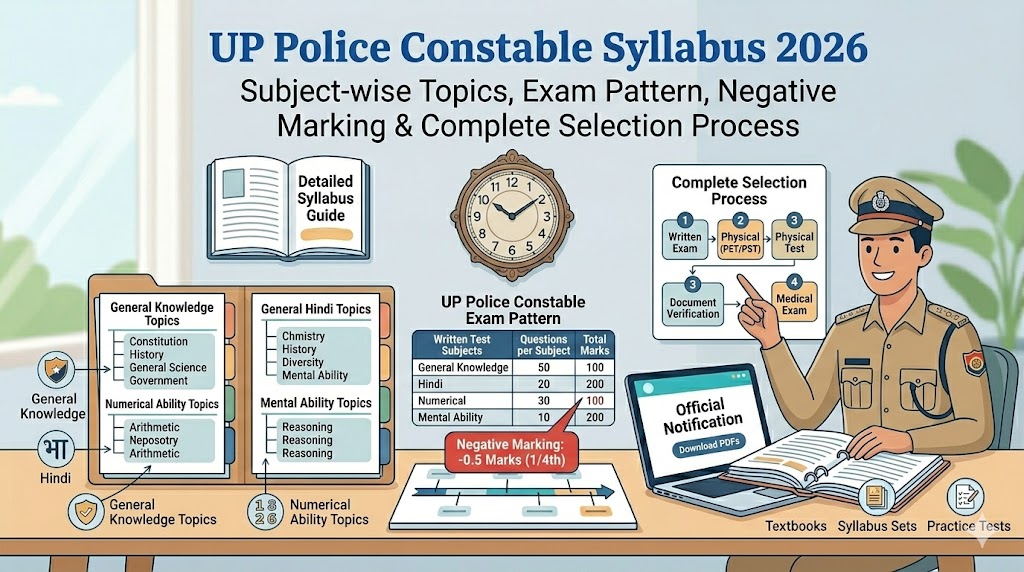
Of all the government job openings in Uttar Pradesh, UP Police Constable is the most accessible — Class 12 pass, UP domicile, and physical fitness. That is the entire eligibility requirement. With 32,679 vacancies on the table, this is a recruitment cycle that serious aspirants simply cannot afford to approach casually.
One thing that consistently separates candidates who get selected from those who do not is this: written exam preparation and physical training must run in parallel from day one. Every year, candidates who rank well on paper fail at the PET stage because they treated the run as an afterthought. Your written rank means nothing if you cannot clear the physical test — selection gets cancelled on the spot.
Two things make the 2026 cycle different from previous UP Police exams. Negative marking has been removed entirely — a wrong answer now scores zero instead of minus 0.5. And the exam remains offline OMR-based, not computer-based. Both of these directly change how you should approach the paper, which this guide explains section by section.
Recruitment at a Glance
Four-Stage Selection Process
Your final rank is permanently set after Stage 1. Stages 2 through 4 only confirm whether you are physically and medically eligible to occupy that rank. There are no marks in PET, PST, or Medical — they are gates, not ladders.
Written Exam Pattern — 150 Questions, 300 Marks, 2 Hours
Every correct answer carries +2 marks. Every wrong answer carries 0 marks — no deduction.
The four sections are nearly equal in weightage — within 2 marks of each other. This means no single section can carry you. A candidate scoring a consistent 70% across all four sections will outrank someone who peaks at 90% in two sections but drops to 50% in the others.
Minimum qualifying marks:
-
General / Unreserved — 30% → 90 marks
-
OBC / EWS — 25% → 75 marks
-
SC / ST — 20% → 60 marks
Note that these are only qualifying thresholds — actual competition typically demands 55–65%+ depending on the year and total applicants.
On the no-negative-marking rule: In previous UP Police cycles, an uncertain guess could cost you 0.5 marks. That risk is gone. Statistically, guessing randomly on a 4-option MCQ gives a 25% chance of adding 2 marks and a 75% chance of scoring zero. Over 20 uncertain questions, attempting all of them is mathematically better than leaving them blank. Attempt every single question — no exceptions.
What Changed in 2026 vs Previous Cycles
Section 1 — General Knowledge / General Science (38 Questions, 76 Marks)
This section covers the widest ground — History, Geography, Polity, Economics, Science, and Current Affairs. The important thing that most coaching material underweights is the UP-specific component. Questions about UP geography, UP history, UP government schemes, and UP current affairs appear consistently and are free marks for candidates who prepare for them deliberately.
History (7–8 Questions)
Ancient and Medieval India:
-
Indus Valley Civilisation — sites, features, decline
-
Vedic period — Rigvedic society, later developments
-
Maurya Empire — Chandragupta, Ashoka’s Dhamma, Rock Edicts
-
Gupta Empire — Golden Age achievements in art, science, literature
-
Buddhism and Jainism — founders, spread, key doctrines
-
Delhi Sultanate — major sultans, administrative system
-
Mughal Empire — Akbar’s Navratnas, Din-i-Ilahi, land revenue system; Aurangzeb
-
Bhakti and Sufi movements — Kabir, Mirabai, Tulsidas, Raidas (all UP-origin saints — high priority for this exam)
Modern India:
-
British expansion — Subsidiary Alliance, Permanent Settlement, drain of wealth
-
Revolt of 1857 — focus specifically on UP centres: Meerut (where the revolt began), Lucknow (Begum Hazrat Mahal), Kanpur (Nana Sahib), Jhansi (Rani Lakshmibai), Mangal Pandey’s role
-
Freedom movements — Non-Cooperation (1920), Civil Disobedience (1930), Quit India (1942)
-
Gandhi, Bhagat Singh, Subhas Chandra Bose — key roles
-
Independence and Partition (1947)
UP-Specific History:
-
Freedom fighters from UP — Chandrashekhar Azad (Allahabad), Ram Prasad Bismil (Shahjahanpur)
-
Awadh Nawabs and their administration
-
Archaeological sites — Hastinapur, Mathura, Sarnath, Kushinagar, Shravasti
Geography (6–7 Questions)
India Geography:
-
Physical divisions — Himalayas, Northern Plains, Deccan Plateau, Coastal Plains
-
Major rivers — Ganga, Yamuna, Brahmaputra, Godavari, Krishna, Kaveri
-
Monsoon mechanism, seasons, cyclones
-
Agriculture — Kharif and Rabi crops, major producing states
-
Resources — minerals, energy, soil types
-
National Parks, Project Tiger, biomes
UP Geography (High Priority):
-
Rivers of UP — Ganga, Yamuna, Ghaghra, Gomti, Rapti, Betwa, Son, Chambal
-
Administrative divisions — 75 districts across 18 divisions
-
Geographical regions — Terai, Bundelkhand plateau, Vindhya ranges
-
Agriculture — sugarcane (UP is India’s largest producer), wheat, rice, potato, mentha (mint)
-
Industries — leather (Agra, Kanpur), carpet weaving (Bhadohi), glass (Firozabad), sugar mills
-
Dams — Rihand, Rajghat, Matatila
-
Wildlife — Dudhwa National Park, Katerniaghat, Chandra Prabha
Indian Polity and Constitution (5–6 Questions)
-
Preamble — key words, significance
-
Fundamental Rights (Part III) — Articles 14, 19, 21, 32
-
Fundamental Duties — Article 51A
-
DPSP — important directives
-
Parliament — Lok Sabha and Rajya Sabha composition and powers
-
President, Vice President — election process and powers
-
Prime Minister and Council of Ministers
-
Governor, Chief Minister, Vidhan Sabha, Vidhan Parishad
-
Judiciary — Supreme Court, High Courts, writ jurisdiction
-
Election Commission, Panchayati Raj (73rd Amendment — three-tier structure)
-
UP-specific — UP Vidhan Sabha strength, Allahabad High Court (largest High Court in India)
Economics (4–5 Questions)
-
GDP, GNP, per capita income, national income — definitions and distinctions
-
NITI Aayog vs Five Year Plans — structure and objectives
-
Inflation — WPI, CPI; RBI tools — repo rate, CRR, SLR
-
Union Budget — fiscal deficit, revenue deficit
-
Central schemes — PM-KISAN, MNREGA, Ayushman Bharat, PM Awas Yojana, Jal Jeevan Mission
-
UP schemes — One District One Product (ODOP), Kanya Sumangala Yojana, Mukhyamantri Abhyudaya Yojana
General Science (8–9 Questions)
Physics: Newton’s Laws, motion, velocity, acceleration — work, energy, power — sound (echo, reflection) — light (reflection, refraction, optical instruments) — Ohm’s Law, circuits — magnetism — atomic structure basics
Chemistry: States of matter — periodic table basics — acids, bases, salts and pH scale — metals vs non-metals, reactivity series — carbon compounds and fuels — pollution types and effects
Biology: Cell structure and functions — human body systems (digestive, respiratory, circulatory, nervous, excretory) — diseases (TB, typhoid, dengue, malaria, COVID) — vitamins, minerals, deficiency diseases — photosynthesis basics
Current Affairs (5–6 Questions)
-
National government decisions, scheme launches
-
International summits — G20, SCO, BRICS outcomes
-
Awards — Bharat Ratna, Padma, Nobel, Arjuna Award
-
Sports — national and international results
-
Science and Technology — ISRO missions, defence developments
-
UP-specific current affairs — state budget, new schemes, infrastructure, appointments, UP Global Investors Summit
Section 2 — General Hindi (37 Questions, 74 Marks)
This is the only section with no English translation — questions and answers are entirely in Hindi. It tests Class 10–12 level grammar and vocabulary.
Grammar topics and expected weightage:
Reading comprehension: 1–2 prose passages (gadyansh) with inference and vocabulary questions, plus 1 poetry passage (padyansh) for theme and figure of speech identification.
Practical Hindi: Fill in the blanks with correct grammatical form, sentence ordering (vakya kram).
Sandhi, Samas, Vilom, Paryayvachi, Muhavare, and Vakya Shuddhi together account for roughly 55–60% of Hindi questions in UP Police exam history. If your time for this section is limited, these six areas alone will carry you through.
Section 3 — Numerical and Mental Ability Test (38 Questions, 76 Marks)
Split roughly into Arithmetic (around 20 questions) and Mental Ability (around 18 questions). The official notification does not specify an exact internal split.
Arithmetic — expected topic-wise distribution:
Percentage + Profit and Loss + SI/CI + Time and Work + Ratio and Proportion together cover approximately 45–50% of arithmetic questions. These five are your core — master them before spending preparation time on mensuration or algebra.
Mental Ability topics:
-
Number and letter series
-
Word and alphabet analogy
-
Coding-decoding
-
Direction sense test
-
Logical diagrams (Venn diagrams)
-
Symbol-relationship interpretation
-
Visual pattern identification
-
Common sense and logical interpretation
-
Evaluating strong vs weak arguments
-
Determining implied meanings from statements
Section 4 — Mental Aptitude / IQ / Reasoning (37 Questions, 74 Marks)
This section has three distinct parts that are frequently confused. Understanding the difference matters because they require completely different preparation approaches.
Mental Aptitude — Unique to UP Police
This sub-section does not appear in SSC, Railway, or banking exams. It tests whether you have the values, orientation, and temperament appropriate for police service — through scenario-based MCQ questions.
Topics covered:
-
Public interest vs personal interest — correct prioritisation
-
Law and order response — procedural correctness in policing scenarios
-
Communal harmony — non-discriminatory response across communities
-
Crime control attitude — proactive vs reactive approach
-
Rule of law — legal process vs personal judgment
-
Gender sensitivity — respectful conduct across all genders
-
Basic police system — structure and functioning of UP Police
-
Basic law awareness — relevant IPC and CrPC provisions
-
Mental toughness — composed response under pressure
-
Sensitivity toward minorities and underprivileged communities
How to prepare for Mental Aptitude: Questions typically present a real policing scenario. Example: “You witness a senior officer accepting money from a civilian. What do you do?” The correct answer always favours public interest, legal procedure, non-discrimination, and professional ethics — never personal loyalty, community bias, or individual judgment. Go through 15–20 sample scenario questions to understand the pattern. Reading UP Police Act basics and knowing Sections 96–106 IPC (right of private defence) and a few major IPC sections will also help.
Intelligence Quotient (IQ)
-
Relationship and analogy tests
-
Spotting the odd one out
-
Series completion — number and letter
-
Coding-decoding
-
Direction sense
-
Blood relations
-
Alphabet-based problems
-
Mathematical operations and IQ reasoning
-
Venn diagrams and chart-based tests
Logical Reasoning
-
Similarities, differences, classification
-
Analytical judgment and decision-making
-
Visual memory and discrimination
-
Abstract symbol relationships
-
Arithmetic reasoning
-
Common sense applications
Physical Standard Test (PST)
Conducted after written exam — qualifying only, no marks:
Female weight: proportionate to height as per government medical standards.
Physical Efficiency Test (PET)
The male standard of 4.8 km in 25 minutes works out to approximately 5 minutes 12 seconds per kilometre — genuinely achievable, but only with 2–3 months of consistent training. Do not start running two weeks before the PET date. Start now. Train to cover 4.8 km in 22 minutes so you have a 3-minute safety margin on the actual day. Candidates who train to exactly the qualifying time often miss it on PET day because of nerves, weather, or an unfamiliar track.
Medical Examination Standards
Age Relaxation
5-Month Preparation Plan
Month 1 — GK Foundation and Hindi Grammar
Start with Lucent’s General Knowledge — cover History, Geography, and Polity with a deliberate focus on UP-specific chapters that most general guides skip. For science, NCERT Class 9–10 Science textbooks are the most efficient source. Hindi grammar: begin with Sandhi, Samas, Vilom Shabd, and Paryayvachi — these four topics give the highest return per preparation hour in the Hindi section. Subscribe to a UP-focused current affairs monthly magazine from this month itself.
Month 2 — Mathematics and Reasoning
NCERT Class 8–10 Maths for Percentage, Profit and Loss, SI/CI, Ratio, Average, and Time and Work. RS Aggarwal Reasoning for Analogy, Series, Coding, Direction Sense, and Blood Relations. Read through UP Police Act basics and work through 15–20 Mental Aptitude sample scenarios to understand the values-based question pattern. Begin 2 km daily runs — not sprint training, steady pace building.
Month 3 — Section-wise Daily Practice
Daily targets: 38 GK questions + 37 Hindi questions in the morning. 38 Maths/Mental Ability + 37 Reasoning/Aptitude in the evening. Two UP Police previous paper section tests per week. Running: build to 3.5 km continuous at a steady pace.
Month 4 — Full Mock Tests
Three full 150-question mock papers per week under a strict 120-minute clock. Target: under 48 seconds average per question. Attempt all 150 every time — no blanks, no skips. Review every wrong answer the same day. Physical training: 4.8 km continuous run.
Month 5 — Revision and PET Readiness
Revise all four sections from notes only — no re-reading full textbooks. Cover the last 8 months of UP current affairs with 30 minutes daily. Running: achieve 4.8 km in under 23 minutes consistently. Final two weeks: only formula sheets, Hindi grammar rules, and quick topic reviews.
Recommended Books
Direct Answers to Common Questions
Is there negative marking in 2026?
No. Wrong answers score zero. The 0.5 deduction from previous cycles has been removed. Attempt all 150 questions without exception.
Is UP domicile mandatory?
Yes. A valid UP domicile certificate is required at Document Verification. Candidates without it are disqualified regardless of written exam score.
Is Class 10 pass sufficient?
No. UP Police Constable requires Class 12 (Intermediate) pass. SSC GD and Railway Group D accept Class 10 — UP Police does not.
Does the PET affect your final rank?
No. PET is qualifying only. Finishing faster does not improve your rank. But failing the PET cancels your selection entirely, regardless of written exam performance.
Is the Mental Aptitude section the same as Reasoning?
No. Mental Aptitude is scenario-based and tests police values — it does not appear in SSC or Railway exams. IQ and Reasoning are separate sub-sections in Section 4 that test standard intelligence and logical ability.
Is the exam online or offline?
Offline — OMR sheet with a pen. Not a computer-based test.
For official notifications, admit card releases, and result updates, always refer to uppbpb.gov.in directly. Do not rely on third-party sites for official dates.
This website is not affiliated with UP Police or any government authority. Content is provided for educational and informational purposes only.
Written by Manish
10+ years teaching experience
Helping students understand exams, results & forms
1 thought on “UP Police Constable 2026 – Complete Syllabus, Exam Pattern & Selection Process”